

Precise words make your message easier to trust. “During” is a useful word, but it appears so often that it fades into the background. Repeat it in a report, an email, or a story, and your writing starts to sound flat. The right alternative shows exactly how two events relate in time. It also sets the tone, from relaxed to formal. This guide gives you 30 clear options, with notes on when each one works.
What Does During Mean?
During is a preposition. It places an event inside a period of time, and it always takes a noun or noun phrase: during the meeting, during summer, during the storm. It carries two senses. The first is “throughout the whole period,” as in “it rained during the night.” The second is “at some point inside the period,” as in “she called during lunch.” Knowing which sense you mean is the first step to picking a better word.
Another Word for During: How to Choose
Start with the time relationship. Ask whether the action covers the entire period, happens at one moment within it, or runs alongside another action. Next, check the tone: casual, neutral, or formal. Finally, check the grammar. Some replacements take a noun, and others need a full clause. Read the sentence aloud once. If it sounds natural, keep it.
During vs While: The Noun Test
Use “during” before a noun. Use “while” before a clause with its own subject and verb. “During the call, he took notes” works. “While he was on the call, he took notes” also works. “During he was on the call” does not. If a noun follows, pick a preposition. If a subject and verb follow, pick a conjunction.
During This Time Synonym: Quick Picks
When you need a during this time synonym, these phrases fit most sentences: “in the meantime,” “in the interim,” “over this period,” “throughout this period,” and “meanwhile.” Use “in the meantime” for casual and neutral writing. Use “in the interim” for formal updates. Use “throughout this period” when the whole span matters. The 30 entries below show how each one behaves.
Throughout
Context & Usage: Throughout means from the start of a period to its end, with no break. It fits everyday speech and formal writing, and it signals consistency and reliability. Use it when you want the reader to feel the full length of the span.
- She stayed calm throughout the interview.
- Prices stayed steady throughout the year.
While
Context & Usage: While joins two actions that happen at the same time, and it needs a clause after it. It is warm, natural, and common in speech. It also shows that one action does not stop the other, which makes your writing feel fluid.
- He read the report while the team waited.
- I sketch ideas while I listen to music.
Over
Context & Usage: Over describes something that unfolds across a stretch of time, such as a weekend or a decade. It sounds relaxed and conversational. It suggests a gradual process rather than a single moment.
- We talked it through over coffee.
- The town changed over the past ten years.
Amid
Context & Usage: Amid means in the middle of something ongoing, usually noise, change, or tension. It works well in news writing and polished prose. It adds a sense of context, as if a bigger event surrounds the main one.
- The team finished the launch amid constant interruptions.
- She kept smiling amid the confusion.
Amidst
Context & Usage: Amidst is a slightly older, more literary form of amid. It suits essays, fiction, and reflective writing. It adds a soft, formal rhythm, though amid is the safer choice in business writing.
- Amidst the noise, he found a quiet corner.
- They built the garden amidst years of hardship.
In the Course of
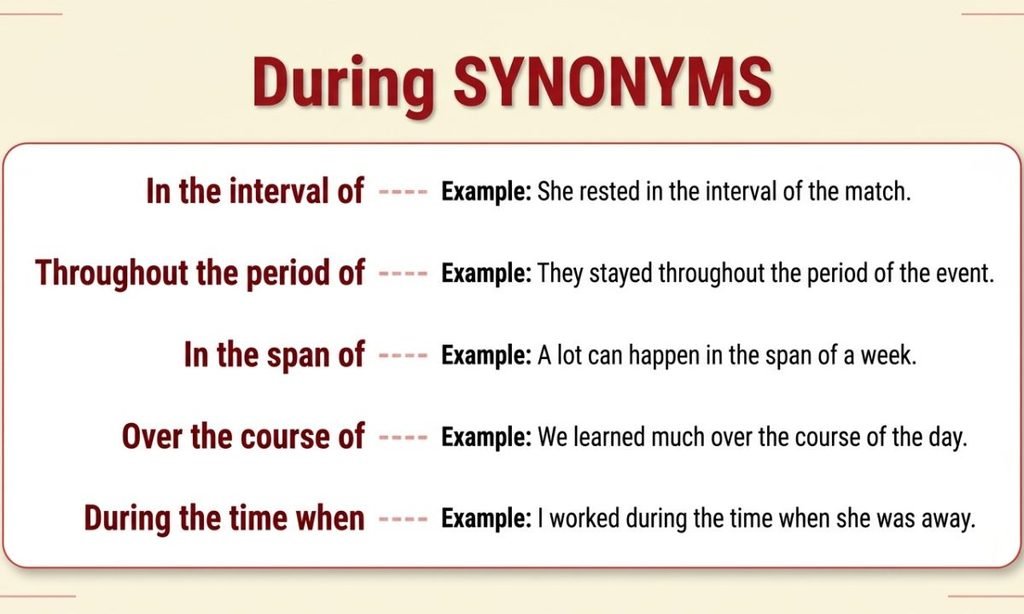
Context & Usage: In the course of means during the process of doing something. It is formal and common in reports, legal text, and professional emails. It makes your message sound measured and careful.
- In the course of our review, we found two errors.
- She learned a lot in the course of her training.
At the Time of
Context & Usage: At the time of points to a specific moment, usually an event. It is neutral and precise, which makes it useful in records, forms, and explanations. It tells the reader exactly when something was true.
- At the time of the call, no one knew the cause.
- The price was lower at the time of purchase.
Pending
Context & Usage: Pending means while waiting for something to be decided or finished. It is formal and common in business, law, and administration. It signals that a matter is open and not yet resolved.
- The account stays active pending final approval.
- Please hold all changes pending our review.
All Through
Context & Usage: All through is a casual form of throughout. It fits spoken English, stories, and friendly messages. It adds warmth and emphasis, and it makes the time feel long and full.
- He talked all through dinner.
- It snowed all through the night.
Meanwhile
Context & Usage: Meanwhile links two things happening at the same time, usually across sentences. It is neutral and works in speech and writing. It helps readers follow parallel events without confusion.
- The chef prepared the sauce. Meanwhile, the team set the tables.
- I waited for the file to load. Meanwhile, I answered emails.
In the Middle of
Context & Usage: In the middle of places an event inside another one that is still in progress. It is casual and clear. It often carries a small note of interruption or pressure.
- She called in the middle of my presentation.
- We lost power in the middle of the storm.
For the Duration of
Context & Usage: For the duration of covers the full length of a period, and it stresses that length. It is formal and common in policies, contracts, and notices. It sounds firm and leaves little room for doubt.
- Please keep your phone off for the duration of the flight.
- The rule applies for the duration of the project.
Concurrently With
Context & Usage: Concurrently with means at the same time as something else, and it sounds technical. It fits project plans, research, and formal reports. It signals planned overlap rather than coincidence.
- The tests ran concurrently with the training sessions.
- Phase two begins concurrently with the audit.
At the Same Time As
Context & Usage: At the same time as is a plain, friendly way to show two things overlapping. It is neutral and easy to read. It keeps the sentence simple when a technical term would feel heavy.
- The update arrived at the same time as the new rules.
- She spoke at the same time as the alarm rang.
In the Interim
Context & Usage: In the interim means in the time between two events. It is formal and polished, and it suits updates and planning notes. It reassures readers that you have a plan for the gap.
- The manager leaves Friday. In the interim, Sam will lead the team.
- Use the old system in the interim.
In the Midst of
Context & Usage: In the midst of means in the thick of something, often busy or difficult. It works in narrative writing and thoughtful prose. It adds depth and a sense of being fully inside the moment.
- We were in the midst of a move when the call came.
- She wrote the speech in the midst of a hectic week.
Over the Course of
Context & Usage: Over the course of describes change or progress across a defined period. It is neutral to formal and common in analysis and reporting. It suits explanations where steps build on each other.
- Over the course of the year, sales doubled.
- He earned trust over the course of several meetings.
Within
Context & Usage: Within places something inside a limit or period. It is neutral to formal, and it fits deadlines and schedules. It gives your sentence a clear boundary, which helps readers plan.
- We will reply within two days.
- Most changes happen within the first month.
In
Context & Usage: In is the simplest swap for during when you mean a general period, such as a season or a year. It is neutral, short, and natural. It keeps sentences light when a longer phrase would add weight.
- The park is busiest in summer.
- She finished the draft in March.
At
Context & Usage: At marks a precise point, such as a meal, an event, or a time of day. It is casual and neutral, and it fits quick, direct sentences. It shows that something happened at one moment, not across the whole period.
- We spoke at lunch.
- He felt calm at the ceremony.
As
Context & Usage: As links two actions that unfold together, and it needs a clause. It is neutral and slightly literary. It creates a smooth sense of motion, which suits storytelling and description.
- The crowd cheered as the runners crossed the line.
- She smiled as she read the note.
Through
Context & Usage: Through means from beginning to end of a period or experience. It is casual and common in speech. It gives the idea of endurance, as if someone carried on until the end.
- They worked through the night.
- He sat through the whole lecture.
Also Read: Synonyms for This: 30 Best Alternatives and When to Use Them
Across
Context & Usage: Across spreads an event over a wide span of time, often a career or an era. It is neutral and fits analysis and features. It gives your writing breadth and a sense of range.
- The theme returns across her four novels.
- Habits form across years, not days.
Whilst
Context & Usage: Whilst is a British form of while, and it is more formal and slightly old-fashioned. It fits British writing, legal text, and a literary voice. Use it with care in American English, where while is the norm.
- He took notes whilst the speaker explained the plan.
- Whilst the work continues, access stays limited.
When
Context & Usage: When ties an event to a moment or a situation, and it needs a clause. It is casual and natural. It makes your sentence feel immediate and conversational.
- Call me when you land.
- The lights went out when the storm hit.
In the Meantime
Context & Usage: In the meantime covers the gap between now and a later event. It is neutral and friendly, and it works in speech and email. It keeps the reader calm by showing what to do while they wait.
- The parts arrive Monday. In the meantime, we will prepare the site.
- In the meantime, please save your work.
In the Span of
Context & Usage: In the span of highlights how short or compact a period was. It is neutral and often used for effect. It adds drama, because it makes the reader notice how much happened in so little time.
- In the span of an hour, the plan changed three times.
- She learned the tool in the span of a weekend.
Mid
Context & Usage: Mid is a short prefix meaning in the middle of, used with a noun, as in mid-sentence or mid-flight. It is casual and punchy. It suits headlines and quick, vivid description.
- He stopped mid-sentence.
- The train halted mid-journey.
For the Length of
Context & Usage: For the length of is a plain, friendly way to say for the whole of a period. It is neutral and easy to follow. It works well in instructions and everyday explanations.
- Stay seated for the length of the show.
- The offer is valid for the length of the trial.
Between
Context & Usage: Between places an action in the gap separating two events or times. It is neutral and common in schedules and plans. Use it when the reader needs to see the start and the end of the window.
- Call me between meetings.
- Deliveries arrive between nine and noon.
Frequently Asked Questions
What is another word for during?
Throughout is the closest match when you mean the whole period, and in or at works for general or single moments.
What is a good during this time synonym?
In the meantime and in the interim are the most natural choices, with meanwhile as a short option.
Can I use while instead of during?
Yes, but while needs a clause with a subject and verb, while during needs a noun.
What are formal other words for during?
In the course of, for the duration of, pending, and concurrently with suit formal writing best.
What is the difference between during and throughout?
During can mean any point inside a period, but throughout means the entire period without a break.
Conclusion
A strong during synonym does more than avoid repetition; it shows how events connect, sets the right tone, and keeps your reader moving. When you know the difference between a whole period, a single moment, and an overlapping action, you stop guessing and start choosing. With these 30 alternatives, you can match each sentence to its exact meaning and write with confidence in emails, reports, and stories.

Hi, my name is Kalvin. I love to read and learn new words every day. On this site, I share easy synonyms and simple grammar tips. Let us learn and write better together!


2 thoughts on “During Synonym: 30 Other Words for During”