
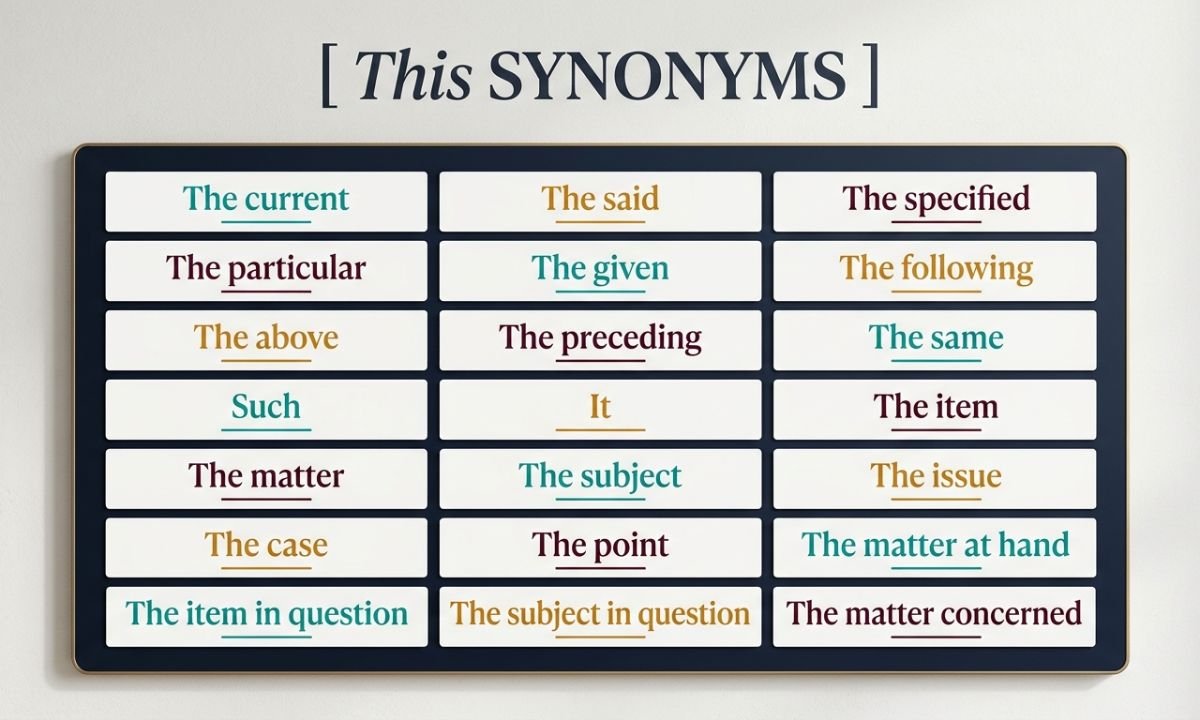
Precise words make your message clear on the first read. The word “this” is useful, but it often leaves the reader guessing. When you repeat it, your writing sounds flat and your point gets blurry. A better synonym for this adds focus, tone, and rhythm in one move. This guide gives you 30 alternatives, each with meaning, context, and examples. Pick the right one and your speech and writing become sharper at once.
What Does “This” Mean? Another Word for This Explained
“This” points to something near in space, time, or conversation. It can be a determiner (“this book”) or a pronoun (“this is ready”). Its plural is “these.”
Because it is so flexible, it is easy to overuse. Another word for this should do one of three jobs: name the thing, mark its distance, or set the tone. Choose by register: casual, neutral, or formal.
This vs That: Clear Rules for the Right Choice
Use “this” for what is close, current, or about to be explained. Use “that” for what is distant, past, or already finished.
- Space: “This chair” is beside you. “That chair” is across the room.
- Time: “This week” is now. “That week” is gone or far off.
- Discourse: “Here is this idea” introduces it. “That idea” refers back to it.
- Emotion: “This” feels personal and close. “That” feels removed.
The same logic applies to “these” and “those.”
This Synonyms and Antonyms: A Quick Sense Map
Synonyms keep the focus near: this one, the present, the current one, here, such. Formal synonyms point back to earlier text: the aforementioned, the above, said, the foregoing.
Antonyms point away: that, those, the other, the former, there. Knowing both sides helps you control distance in every sentence.
How to Avoid Overusing “This” in Writing
Name the referent. Instead of “This caused delays,” write “The software update caused delays.” Add a noun after “this” when the target is unclear. Swap in a synonym when the same word appears twice in one paragraph. Read your draft aloud and mark every “this” that could point to two things.
1. This One
Context & Usage: “This one” picks a single item from a group and keeps speech natural. It fits shopping, choosing, and casual comparison. It adds clarity and a warm, direct tone.
Examples:
- I like this one better than the blue shirt.
- Can you pass me this one from the shelf?
2. Such
Context & Usage: “Such” refers to a type or kind of thing rather than one object. It suits explanations and general statements. It adds a polished, flowing tone without repeating the noun.
Examples:
- Such mistakes are easy to fix with practice.
- We avoid such shortcuts in our process.
3. It
Context & Usage: “It” replaces “this” when the referent is already obvious. It keeps fast conversation light and uncluttered. It lowers repetition and makes sentences easier to say.
Examples:
- It works perfectly after the reset.
- I read the report, and it explains everything.
4. Here
Context & Usage: “Here” points to a place or moment close to the speaker. It works when you present something right in front of the listener. It feels friendly, immediate, and clear.
Examples:
- Here is the file you asked for.
- Put the box here, next to the door.
5. The Present
Context & Usage: “The present” refers to the thing under discussion right now. It belongs to formal reports, legal notes, and academic writing. It signals focus and a serious tone.
Examples:
- The present study examines sleep and memory.
- The present agreement replaces all earlier terms.
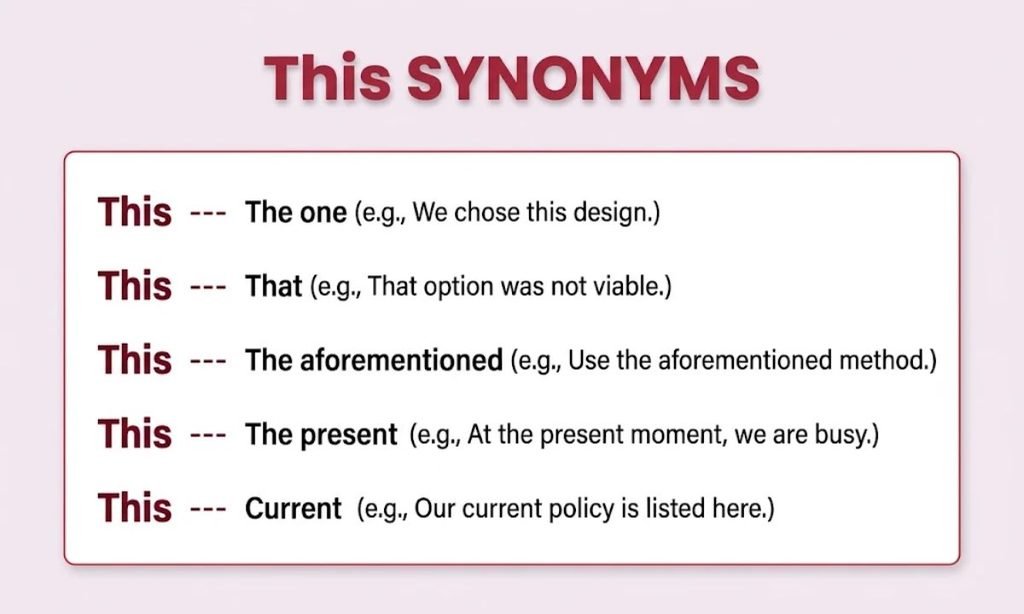
6. The Aforementioned
Context & Usage: “The aforementioned” points back to something named earlier in the text. It suits contracts, formal letters, and official documents. It adds precision, though it can sound stiff in casual talk.
Examples:
- The aforementioned policy applies to all staff.
- Please review the aforementioned clauses before signing.
7. The Above
Context & Usage: “The above” refers to content that appears earlier on the page. It works in emails, guides, and formal notes. It saves space and keeps readers anchored.
Examples:
- The above steps will fix most login errors.
- Please confirm the above details by Friday.
8. The Following
Context & Usage: “The following” introduces what comes next. It suits instructions, lists, and announcements. It builds clear expectation and keeps the reader moving.
Examples:
- Please bring the following documents to the interview.
- The following rules apply during the exam.
9. Said
Context & Usage: “Said” is a legal-style word meaning the one already mentioned. It fits contracts and technical documents, not daily speech. It gives exact reference and a formal edge.
Examples:
- The tenant must return said keys on departure.
- Said device must be tested before use.
10. The Indicated
Context & Usage: “The indicated” refers to something pointed out, marked, or shown. It works in manuals, forms, and technical directions. It adds exactness and a neutral, professional tone.
Examples:
- Fill in the indicated fields only.
- Use the indicated route during the evacuation drill.
11. Herein
Context & Usage: “Herein” means in this document or in this place. It appears in legal and formal writing. It gives authority, but overuse makes text heavy.
Examples:
- The terms described herein are final.
- All data herein remains confidential.
12. The Current One
Context & Usage: “The current one” separates the active item from older or future ones. It fits software, plans, and everyday comparison. It communicates timing and removes confusion.
Examples:
- The current one is faster than the old model.
- I prefer the current one to the draft from last week.
13. The Latter
Context & Usage: “The latter” points to the second of two items just mentioned. It works in comparisons and balanced arguments. It keeps sentences tight and shows careful structure.
Examples:
- We tested a paper plan and a digital plan, and the latter won.
- Between tea and coffee, I choose the latter.
Also Read: During Synonym: 30 Other Words for During
14. This Particular
Context & Usage: “This particular” narrows the focus to one specific item. It suits moments when a general idea needs a clear target. It adds emphasis and shows deliberate choice.
Examples:
- This particular design solves our storage problem.
- I chose this particular route for the view.
15. The Given
Context & Usage: “The given” refers to something already supplied or stated. It fits math, planning, and academic tasks. It sounds neutral and supports logical flow.
Examples:
- Solve the problem within the given limits.
- The given data supports our conclusion.
16. The Stated
Context & Usage: “The stated” refers to something already declared in words. It works in reports, policies, and formal feedback. It signals accuracy and holds the writer to the record.
Examples:
- The stated goal was to cut costs by ten percent.
- We met the stated requirements.
17. The Named
Context & Usage: “The named” points to a person or item identified earlier. It suits official notices and contracts. It gives clear reference and a precise, formal tone.
Examples:
- The named applicant will receive an email.
- Only the named guests may enter.
18. The Mentioned
Context & Usage: “The mentioned” refers to something brought up earlier, usually in a short phrase. It fits business messages and reports. It keeps the tone businesslike and the reference clear.
Examples:
- The mentioned issue is now resolved.
- Please share the mentioned files with the team.
19. The Selected
Context & Usage: “The selected” refers to an option already chosen. It works in menus, apps, and decision notes. It confirms a choice and reduces doubt.
Examples:
- The selected plan starts next month.
- Click the selected item to edit it.
20. The Same
Context & Usage: “The same” refers back to an item already discussed, often in formal or older style. It suits repeated references in business writing. It ties sentences together and avoids needless repetition.
Examples:
- Please sign the form and return the same by Monday.
- We received the package and inspected the same.
21. The Matter at Hand
Context & Usage: “The matter at hand” names the issue being discussed now. It fits meetings, debates, and serious talks. It pulls attention back to the point and keeps the conversation on track.
Examples:
- Let us return to the matter at hand.
- The matter at hand needs a decision today.
22. At Hand
Context & Usage: “At hand” describes something close in time or space and ready to use. It works in advice and planning. It adds a calm, practical tone.
Examples:
- Keep the tools at hand while you work.
- The task at hand is simple.
23. This Very
Context & Usage: “This very” stresses that you mean exactly this one, now. It suits storytelling and strong statements. It adds energy and a personal, urgent feel.
Examples:
- This very room hosted the first meeting.
- I solved it at this very moment.
24. Hereby
Context & Usage: “Hereby” means by this act or this statement. It appears in official declarations and formal notices. It adds weight and shows that the words themselves create the action.
Examples:
- I hereby confirm my resignation.
- We hereby invite you to the ceremony.
25. As Such
Context & Usage: “As such” means in that role or by its own nature. It links a fact to its result. It improves logic and keeps arguments tight.
Examples:
- She is the manager and, as such, signs the budget.
- The tool is a draft and should be treated as such.
26. Like This
Context & Usage: “Like this” shows a way or example close to the speaker. It fits demonstrations, teaching, and casual advice. It feels warm and easy to follow.
Examples:
- Hold the pen like this.
- Write your email like this: short, clear, and polite.
27. So
Context & Usage: “So” replaces “this” when it shows degree, as in “this much.” It suits everyday speech and informal writing. It is short, natural, and quick.
Examples:
- I did not expect it to be so easy.
- The room was so quiet that we whispered.
28. The Current
Context & Usage: “The current” marks something active right now, as opposed to past or future. It fits reports, news, and project updates. It creates clear timing without extra words.
Examples:
- The current version has fewer bugs.
- Our current focus is customer support.
29. The Foregoing
Context & Usage: “The foregoing” refers to everything stated just before. It suits legal and academic writing. It sums up earlier points and adds a formal close.
Examples:
- In light of the foregoing, we accept the offer.
- The foregoing arguments support our claim.
30. The Aforesaid
Context & Usage: “The aforesaid” is a strict legal term for something named before. It belongs in contracts and formal deeds. It gives exact reference, but sounds heavy outside legal work.
Examples:
- The aforesaid property belongs to the seller.
- The aforesaid terms remain in force.
Frequently Asked Questions
What is another word for this?
“This one,” “the present,” “the current one,” and “such” are common choices, depending on tone.
What are synonyms of the word this?
Core synonyms include this one, here, it, the present, the above, and the aforementioned.
When should I use this vs that?
Use “this” for what is near or current, and “that” for what is distant or already past.
Can I say “such” instead of this?
Yes, when you mean a type or kind of thing, not one exact object.
How do I avoid overusing “this” in an essay?
Name the noun, choose a precise synonym, and check that every “this” has one clear referent.
Conclusion
Mastering these 30 alternatives turns a vague pointer into a precise tool. You now know when to choose a casual option like “this one,” a neutral one like “the current,” or a formal one like “the foregoing.” Each choice sharpens your meaning, sets the right tone, and removes guesswork for the reader. With practice, you will write and speak with more clarity, variety, and confidence.

Hi, my name is Kalvin. I love to read and learn new words every day. On this site, I share easy synonyms and simple grammar tips. Let us learn and write better together!


3 thoughts on “Synonyms for This: 30 Best Alternatives and When to Use Them”