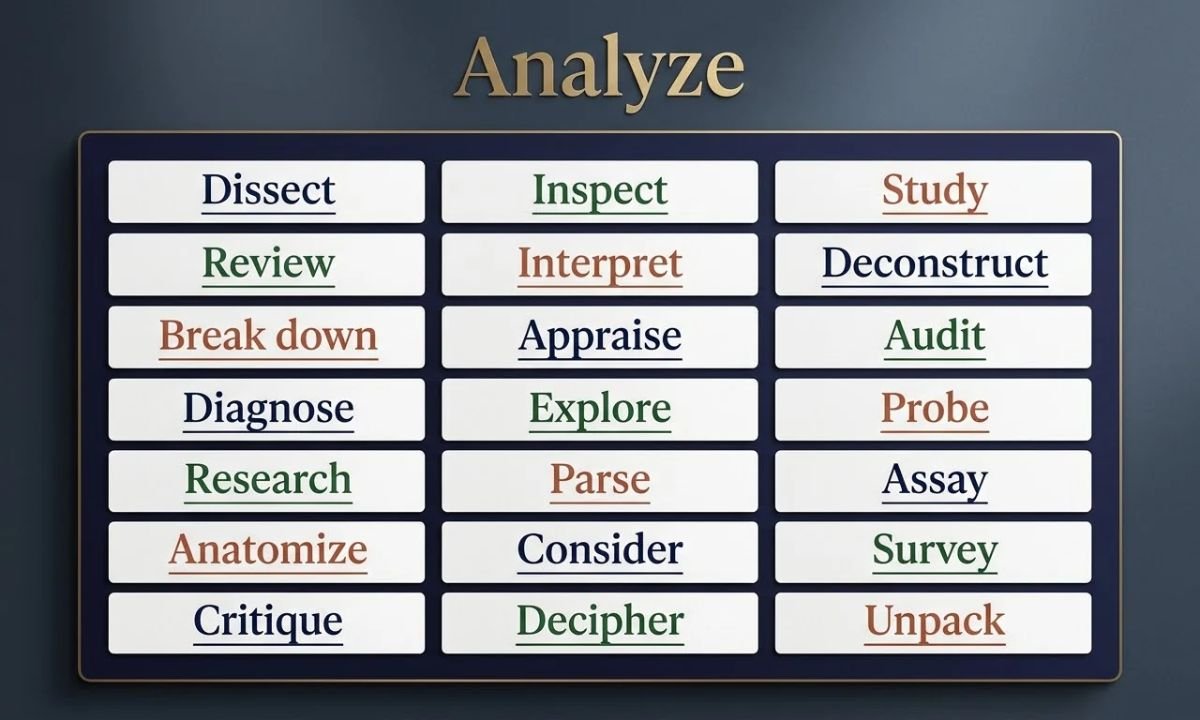
To analyze means to examine something closely so you can understand its parts, its meaning, or its value. It is one of the most common verbs in work, school, and daily talk. Because it is so common, it often ends up vague. Precise vocabulary tells your reader exactly what you did, how deeply you looked, and what you found. This guide gives you synonyms for analyze, grouped by context, tone, and purpose, so you can pick the right one every time.
What Does “Analyze” Actually Mean?
Analyze carries two meanings. The first is to study something closely to judge its nature or worth. The second is to break a complex whole into smaller parts so each can be understood.
The word comes from the Greek analyein, which means “to dissolve” or “to loosen.” That origin still helps. If you are pulling something apart to understand it, analyze fits. If you are only describing it, it does not.
Replace analyze when:
- You want to show how deep or how formal the work was
- You have used it three times in one page
- The reader needs to know the method, such as measuring, comparing, or testing
Analyze vs. Evaluate vs. Assess
These three get swapped constantly, but they do different jobs.
- Analyze breaks something into parts to see how it works.
- Evaluate judges quality or value against a standard.
- Assess measures the size, level, or condition of something.
A quick test: if you are asking “how does this work?”, analyze. If you are asking “how good is this?”, evaluate. If you are asking “how much, or how bad?”, assess.
One warning for students. Summarize and describe are not synonyms for analyze. A summary repeats what a text says. An analysis explains why it says it and what that means. Swapping them in an essay can cost you marks.
Quick-Reference Matrix: Match the Input to the Verb
Most word lists are long and flat. This table works faster. Find what you are working with, then pick the verb.
| What you are working with | Best verb | Why it fits |
| Numbers and trends | Quantify, model, benchmark | Signals measurable work |
| Financial records | Audit, appraise | Implies checking against a standard |
| A poem, speech, or essay | Interpret, unpack, deconstruct | Focuses on meaning and structure |
| Code, text, or data format | Parse | Describes splitting into readable parts |
| A problem or failure | Diagnose, investigate, probe | Points toward cause |
| A document or process | Review, inspect | Neutral and professional |
| A new topic | Study, explore, research | Suggests learning rather than judging |
Tone Warning: Words That Sound Too Critical
Not every synonym is neutral. Some carry an edge that can land badly in workplace emails.
- Neutral: examine, review, study, assess, look into
- Intense: scrutinize, probe, dissect, interrogate
- Fault-finding: pick apart, tear down, critique
“We will dissect your report” sounds like an attack. “We will review your report” sounds like teamwork. When the audience is a client, a manager, or a colleague you want to keep on your side, stay in the neutral group.
US vs. UK Spelling and Style
Americans write analyze. The British write analyse. The same split applies to analyzed and analysed, and to analyzing and analysing. The noun is analysis in both.
Pick one and stay consistent. AP style and most US business writing use the z. Oxford and most UK publications use the s. If your audience is global, match the spelling of the region where the document will be read.
Idioms also differ. Americans often say “dig into the numbers.” British writers more often say “go through the figures.” Both mean the same thing.
Resume Tip: Stronger Words for Analyze (and an ATS Warning)
On a resume, “analyzed” is weak because it hides what you did. The best fix is a specific verb paired with a result.
- Weak: Analyzed booking data.
- Strong: Modeled two years of booking data and raised load factor by four points.
Applicant tracking systems scan for keywords from the job post. If the posting says “data analysis,” keep the word analyzed somewhere on your resume. Do not replace it everywhere with rare words like assayed or anatomized. Use a precise verb in most bullets and keep the exact keyword in at least one.
Better Verbs for AI Prompts
The verb you choose changes what an AI tool gives back. “Analyze this report” is open-ended, so the answer can drift. A sharper verb sets the job.
- Summarize returns a short version of the content.
- Parse returns structured pieces, such as a list of fields.
- Audit returns a checklist of problems.
- Critique returns weaknesses and fixes.
- Interpret returns meaning and implications.
- Benchmark returns a comparison against a standard.
Name the verb, name the output, and the result improves.
28 Synonyms for Analyze
Below are 28 other words for analyze, each with a meaning, a best-fit situation, and two example sentences. Every entry is a real working alternative, not filler.
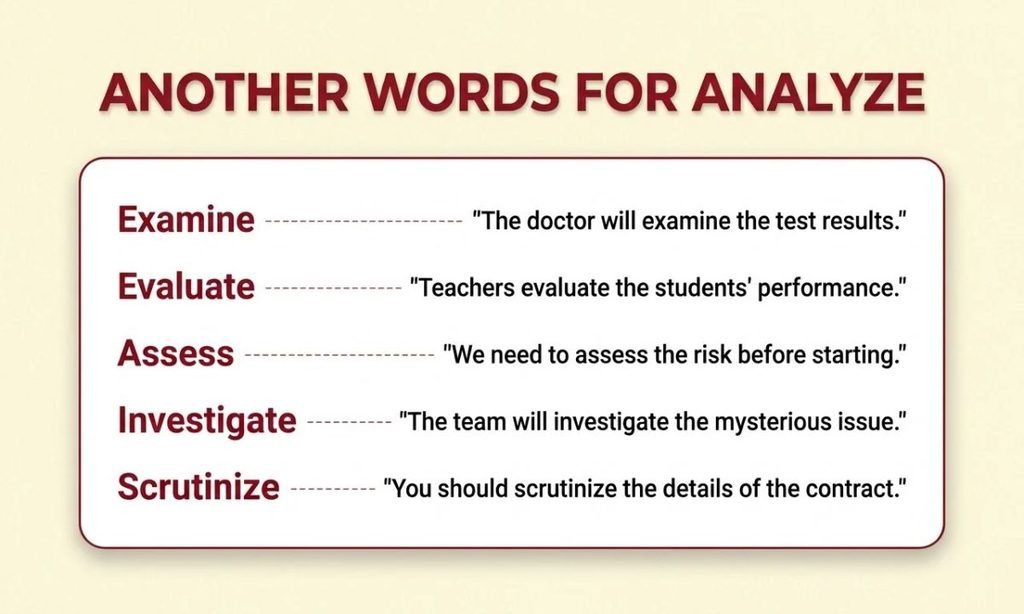
1. Examine
Examine means to look at something carefully and in detail. It fits everyday, school, and business settings and sounds calm and thorough. It tells the reader you are taking your time.
- The doctor will examine the test results this afternoon.
- Let’s examine the contract before we sign it.
2. Evaluate
Evaluate means to judge the quality or value of something against a standard. It fits performance reviews, product choices, and grading. It gives your reader a sense of fairness and structure.
- We evaluate every vendor on price and reliability.
- She evaluated the proposal and recommended approval.
3. Assess
Assess means to measure the size, level, or condition of something. It fits risk checks, injuries, and early project stages. It sounds measured and responsible.
- The team will assess the damage on Monday.
- He assessed the risks before launching the campaign.
4. Scrutinize
Scrutinize means to inspect something with extreme care, often to find flaws. It fits legal, financial, and quality work. It signals high standards, but it can sound harsh, so use it with care.
- Auditors scrutinize every expense report.
- I scrutinized the fine print and found a hidden fee.
5. Investigate
Investigate means to look into something to find facts or causes. It fits problems, complaints, and unexplained results. It builds trust because it shows you are searching for answers.
- We will investigate why sales dropped in March.
- The engineer investigated the cause of the outage.
6. Dissect
Dissect means to take something apart piece by piece to study each part. It fits detailed reviews of arguments, plays, and strategies. It feels intense, so save it for settings where depth is welcome.
- The class dissected the speech line by line.
- Analysts dissected the merger to see where it went wrong.
Do not miss this: Synonyms for Resilient: 25 Better Words by Context and Tone
7. Break Down
Break down means to split something complex into simpler parts. It fits conversations, presentations, and teaching. It feels friendly and clear, and it makes hard topics feel manageable.
- Let me break down the budget for you.
- She broke down the process into four easy steps.
8. Interpret
Interpret means to explain what data, text, or behavior means. It fits literature, research, and any task where meaning is not obvious. It shows you add insight rather than repeat facts.
- Researchers interpret the results in light of earlier studies.
- How would you interpret her silence in that meeting?
9. Review
Review means to go over something again to check it or form an opinion. It fits documents, plans, and code. It is neutral and polite, which makes it a safe choice at work.
- Please review the draft and send me your notes.
- We reviewed last quarter’s numbers together.
10. Inspect
Inspect means to check something closely for condition or defects. It fits buildings, equipment, and quality control. It suggests care and responsibility.
- The mechanic will inspect the brakes today.
- An officer inspected the shipment at the border.
11. Study
Study means to learn about something through focused attention. It fits research, school, and new subjects. It sounds curious rather than critical.
- We studied customer behavior for six months.
- He studied the map before choosing a route.
12. Appraise
Appraise means to estimate the value or quality of something. It fits property, art, and formal performance reviews. It adds a sense of expertise and authority.
- A surveyor appraised the house at a fair price.
- The manager appraised each candidate’s strengths.
13. Audit
Audit means to check records or processes against a set standard. It fits finance, security, and compliance. It signals rigor and accountability.
- The firm will audit our accounts in January.
- I audited the website and found twelve broken links.
14. Parse
Parse means to split text or data into parts so it can be understood or processed. It fits grammar, programming, and detailed reading. It tells your reader you worked through structure, not just content.
- The script parses each log file into separate fields.
- Lawyers parsed the clause to understand its exact limits.
15. Diagnose
Diagnose means to identify the cause of a problem by studying its signs. It fits health, technology, and business trouble spots. It gives your reader confidence that a fix is coming.
- The technician diagnosed a faulty power supply.
- We need to diagnose why customers keep leaving.
16. Explore
Explore means to study something openly without a fixed answer in mind. It fits early research and brainstorming. It feels curious and low pressure.
- Let’s explore a few pricing options.
- The report explores how remote work affects teams.
17. Probe
Probe means to question or test deeply to uncover hidden facts. It fits investigations, interviews, and technical testing. It sounds serious and can feel sharp.
- Reporters probed the company’s safety record.
- The tester probed the system for weak points.
18. Deconstruct
Deconstruct means to take apart an idea or work to reveal how it was built. It fits criticism, design, and media studies. It shows you can see structure beneath the surface.
- The essay deconstructs the way advertisers build trust.
- We deconstructed the winning pitch to learn from it.
19. Critique
Critique means to give a detailed judgment of strengths and weaknesses. It fits creative work, strategy, and peer review. It shows engaged, honest feedback when used kindly.
- She critiqued the design with clear, useful notes.
- Students critique each other’s drafts every week.
20. Research
Research means to gather and study information on a topic in a planned way. It fits school, business, and product work. It signals effort and credibility.
- I researched five competitors before writing the plan.
- The team is researching how people choose a bank.
21. Look Into
Look into means to check on something to learn more. It fits casual and workplace talk. It sounds helpful and relaxed, which calms worried people.
- I’ll look into the billing error today.
- Can you look into why the file won’t open?
22. Dig Into
Dig into means to explore something deeply and with energy. It fits conversations about data, problems, and long reports. It feels hands-on and engaged.
- We dug into the survey results over lunch.
- Let’s dig into what went wrong last quarter.
Do not miss this: Synonyms for Foster: 30 Better Words by Context
23. Unpack
Unpack means to open up a complex idea and explain its parts. It fits meetings, essays, and talks. It makes the reader feel guided rather than lectured.
- Let’s unpack what this policy change means for us.
- The author unpacks the poem’s central image.
24. Weigh
Weigh means to compare pros and cons before deciding. It fits choices and trade-offs. It shows careful thought without sounding cold.
- She weighed the offer against her current job.
- We weighed cost against speed and chose the faster option.
25. Quantify
Quantify means to express something as a number. It fits metrics, reports, and resumes. It proves your claim with evidence.
- We quantified the time savings at ten hours a week.
- The study quantifies how sleep affects focus.
26. Benchmark
Benchmark means to compare performance against a standard or a peer. It fits business, sports, and technology. It shows you know where you stand.
- We benchmarked our load times against three rivals.
- The report benchmarks salaries across the industry.
27. Model
Model means to build a simplified version of a situation to test outcomes. It fits finance, science, and planning. It signals skill with data and forward thinking.
- She modeled three revenue scenarios for next year.
- Engineers modeled the bridge under heavy wind.
28. Gauge
Gauge means to estimate how strong, large, or likely something is. It fits opinions, reactions, and early readings. It sounds practical and quick.
- We sent a short poll to gauge interest in the event.
- He tried to gauge her mood before bringing it up.
How to Choose the Right Synonym
Pick your verb in three quick steps.
- Name the action. Did you measure, compare, take apart, or explain?
- Check the audience. A client wants neutral words. A research team can handle technical ones.
- Add the result. A good verb plus an outcome beats any rare word.
In an essay, use academic synonyms for analyze such as interpret, examine, deconstruct, and evaluate. For synonyms for data analysis, lean on quantify, model, benchmark, and parse. For everyday talk, break down, look into, and unpack read best.
Common Mistakes to Avoid
- Chasing rare words. Obscure verbs confuse readers and can hurt resume keyword matching.
- Treating all synonyms as equal. Each word carries its own depth and tone.
- Mixing up summary and analysis. Summarizing repeats. Analyzing explains.
- Switching spelling styles. Stay with analyze or analyse throughout.
- Skipping the result. A strong verb needs a finding or outcome to back it up.
Frequently Asked Questions
What is the most professional synonym for analyze?
Examine, evaluate, and review are the safest professional choices because they are precise and neutral.
What is a stronger word for analyze on a resume?
Use a specific verb such as modeled, audited, diagnosed, or quantified and pair it with a measurable result.
Is “break down” too informal for business writing?
No, it works well in meetings and emails, though a formal report may prefer examine or evaluate.
What is the difference between analyze and evaluate?
Analyze breaks something into parts to understand it, while evaluate judges its quality against a standard.
What is the opposite of analyze?
The closest opposites are synthesize, combine, and overlook, since they join parts together or skip the close look.
Conclusion
Mastering these synonyms for analyze gives you a sharper way to say what you actually did, whether you measured, questioned, compared, or explained. The right verb tells your reader the depth of your work, sets the tone you want, and removes the guesswork.
Use the matrix to match the word to the task, keep an eye on tone and spelling, and pair every strong verb with a clear result. With practice, you will write and speak with more clarity and speak up with more confidence, and your point will land the first time.

Hi, my name is Kalvin. I love to read and learn new words every day. On this site, I share easy synonyms and simple grammar tips. Let us learn and write better together!