
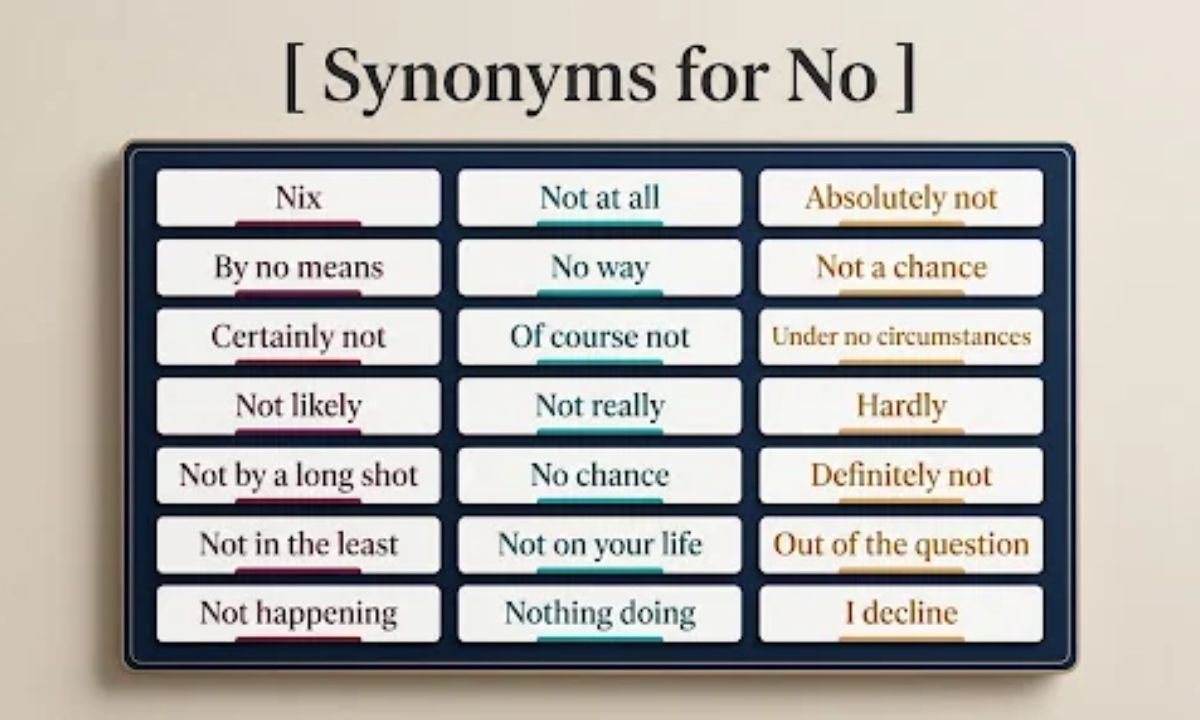
The word “no” is short, clear, and often too blunt. Used in the wrong place, it can sound cold, rude, or careless. Used with precision, it protects your time and your relationships. The right alternative to “no” signals respect, firmness, humor, or authority. This guide groups 60 other words for no by tone, formality, and setting. Each one comes with context and two examples, so you can choose with confidence.
What Does “No” Mean?
“No” is a negative answer. It expresses refusal, rejection, disagreement, or inability. It can also mean “none” or “not any,” as in “no time left.”
That range explains why one-to-one replacements rarely work. A word that fits a quantity (“none”) fails as a refusal. A word that fits a refusal (“I decline”) sounds odd as a casual reply. Good word choice starts by identifying which meaning you need.
The Three Grammatical Roles of “No”
Most word lists ignore grammar, and that causes mistakes. Dictionaries such as Merriam-Webster, Collins, and Cambridge treat “no” in three roles.
- Adverb: “Never,” “not at all,” and “by no means” negate an action or quality.
- Noun: “Refusal,” “veto,” “rejection,” and “denial” name the act of saying no.
- Interjection: “Nope,” “nah,” and “no way” work as standalone replies, often with emotion.
Match the role first. You cannot write “She gave a nope.” You can write “She gave a refusal.”
When Should You Use Another Word for No?
Swap “no” when it feels too sharp, too vague, or too weak for the moment. Common triggers include:
- Declining an invitation without hurting feelings.
- Rejecting a request at work while keeping goodwill.
- Setting a firm boundary with a friend, client, or family member.
- Adding humor to a casual reply.
- Writing formally, where “no” can sound abrupt.
Sometimes plain “no” is best. Safety, consent, and legal matters often need the shortest possible word.
How to Say No Politely Without Sounding Rude
A polite refusal follows a simple formula: appreciation + clear refusal + optional alternative.
- Thank the person. Acknowledge the offer or request.
- State the refusal clearly. Do not hide it inside vague language.
- Offer a brief reason or alternative. Keep it short. You owe an explanation less often than you think.
Example: “Thanks for thinking of me. I can’t join the project this quarter, but I can review the draft next week.” The refusal is firm, the tone is warm, and the next step is clear.
How to Choose the Right Register
Register means the level of formality in your language. Use this quick guide:
- Formal: Writing, official replies, and unfamiliar audiences.
- Polite: Friends, colleagues, and customers.
- Casual: Close friends, texts, and chat.
- Strong: Firm boundaries and emphatic answers.
- Humorous: Light moments with people who share your sense of humor.
Sarcastic and dramatic phrases carry risk. “Fat chance” and “over my dead body” can sound hostile in a workplace email. Read the room before you send.
Formal Synonyms for No
Use these in business letters, official responses, and academic writing.
I Decline
Context & Usage: A direct, formal refusal of an offer or invitation. It sounds firm but courteous. It works best in writing.
- I decline the nomination with gratitude.
- After careful thought, I decline your offer.
Unfortunately Not
Context & Usage: A soft, formal answer that signals regret. It cushions bad news without hiding it. It suits customer service and professional replies.
- Will the report be ready today? Unfortunately not.
- Can we extend the deadline? Unfortunately not.
I’m Afraid Not
Context & Usage: A polite, slightly old-fashioned refusal. “Afraid” here means “sorry,” not fearful. It softens disappointing answers in speech and email.
- Is the table still available? I’m afraid not.
- Can I get a refund? I’m afraid not.
Regrettably, No
Context & Usage: A formal refusal that names your regret. It is best for official notices and rejection letters. It can feel stiff in conversation.
- Regrettably, no exceptions can be made.
- Regrettably, no positions are open at this time.
Under No Circumstances
Context & Usage: A formal, absolute prohibition. It leaves no room for negotiation. Use it for rules, safety, and security.
- Under no circumstances should you share your password.
- Under no circumstances will we release client data.
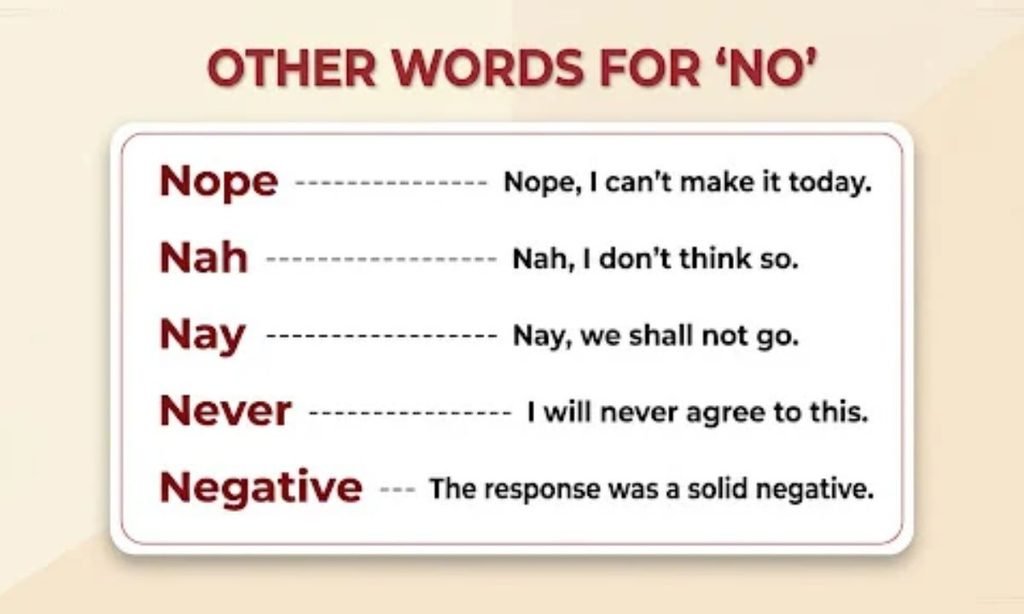
Negative
Context & Usage: A clipped, technical way to say no. It appears in military, aviation, and security speech. In daily conversation it sounds robotic or joking.
- Did the system respond? Negative.
- Are we cleared to proceed? Negative.
Declined
Context & Usage: A one-word status for business forms and official records. It states the outcome without emotion. It fits documents, not conversation.
- Request declined due to missing documents.
- The payment was declined by the bank.
By No Means
Context & Usage: A formal adverb phrase that means “not at all.” It strengthens a negative statement. It works well in essays and speeches.
- Is the project finished? By no means.
- This is by no means a final decision.
Polite Ways to Say No
These keep the relationship intact. They suit invitations, requests, and everyday offers.
No, Thank You
Context & Usage: The classic polite refusal. It is clear, kind, and complete on its own. It works with strangers, hosts, and salespeople.
- Would you like dessert? No, thank you.
- No, thank you, I already have a ticket.
I’d Rather Not
Context & Usage: A gentle refusal based on personal preference. It sets a boundary without a long reason. It fits sensitive or personal questions.
- Want to talk about it? I’d rather not.
- I’d rather not lend my car.
Not Today
Context & Usage: A light refusal tied to timing. It suggests the answer may change later. Use it when you want to stay open without committing.
- Coffee after work? Not today.
- Want to see the new office? Not today.
Maybe Another Time
Context & Usage: A warm decline that keeps the door open. Use it only if you mean it. Otherwise it can feel like false hope.
- Dinner Friday? Maybe another time.
- I can’t make the trip, but maybe another time.
Thanks, but I Can’t
Context & Usage: A friendly refusal that thanks the person first. It follows the appreciation-plus-refusal formula. It suits texts and quick conversations.
- Thanks, but I can’t cover your shift.
- Thanks, but I can’t make it tonight.
I Appreciate It, but No
Context & Usage: A respectful refusal for offers made with good intentions. It honors the gesture while rejecting the substance. It is useful with persistent friends or relatives.
- I appreciate it, but no. I’m comfortable here.
- I appreciate the gift, but no, I can’t accept it.
Not at This Time
Context & Usage: A neutral, professional decline linked to the present moment. It avoids closing the door permanently. It works in sales, hiring, and customer service.
- We’re not hiring at this time.
- I’m not taking new clients at this time.
I Wish I Could
Context & Usage: An empathetic refusal that shows you would help if you could. It works best when the limit is real. Overusing it can sound insincere.
- I wish I could, but I’m booked all week.
- I wish I could help with the move.
Casual and Informal Synonyms for No
Use these slang and everyday options with friends, family, and in texts.
Nope
Context & Usage: A quick, relaxed “no” with a crisp, final tone. It is a real informal word found in dictionaries. Avoid it in formal writing.
- Did you eat yet? Nope.
- Nope, I haven’t seen it.
Nah
Context & Usage: A laid-back refusal that sounds easygoing and slightly dismissive. It is common in speech and chat. Skip it in professional settings.
- Want to go out? Nah, I’m tired.
- Nah, I’m good.
Not Really
Context & Usage: A mild “no” that softens the answer. It suggests partial or lukewarm disagreement. It is useful when a flat refusal feels harsh.
- Did you enjoy the movie? Not really.
- Are you busy? Not really.
I’ll Pass
Context & Usage: A casual refusal of an offer or activity. It is brief and friendly. It carries little emotional weight.
- Karaoke tonight? I’ll pass.
- I’ll pass on seconds, thanks.
Uh-uh
Context & Usage: A spoken sound for “no,” usually with a closed mouth and falling tone. It is common in speech but awkward in writing. Use it with people you know well.
- Did you take it? Uh-uh.
- Uh-uh, not this time.
Nuh-uh
Context & Usage: A playful, childlike denial. It often answers a claim, not an offer. Tone is everything: it can sound teasing or stubborn.
- You forgot the keys. Nuh-uh, they’re right here.
- Nuh-uh, I never said that.
Count Me Out
Context & Usage: An informal way to withdraw from a plan or group activity. It sounds decisive and friendly. Use it when you want a clear exit.
- Skydiving? Count me out.
- Count me out of the group bet.
Not Happening
Context & Usage: A flat, informal refusal with a firm edge. It rejects ideas or requests you will not consider. Use it with people who know your humor.
- Wake up at five on Saturday? Not happening.
- A fourth pet? Not happening.
Strong and Emphatic Ways to Say No
These raise the intensity. Use them to set boundaries or answer extreme requests.
Absolutely Not
Context & Usage: A strong, natural refusal that leaves no doubt. It is more idiomatic than “absolutely no” as a standalone reply. It works for firm boundaries.
- Can I read your messages? Absolutely not.
- Absolutely not, that is unsafe.
No Way
Context & Usage: An emphatic refusal that can also express disbelief. Context decides the meaning. It is informal and expressive.
- Lend him my laptop? No way.
- No way, you won the lottery?
Not a Chance
Context & Usage: A firm answer that suggests the outcome is impossible or unacceptable. “No chance” is a close variant. It fits both serious and playful moments.
- Will I sign that contract? Not a chance.
- Not a chance we finish by noon.
Out of the Question
Context & Usage: A formal-leaning phrase that shuts down a request completely. It signals you will not discuss it. It works in speech and writing.
- A late payment is out of the question.
- Leaving early is out of the question.
Never
Context & Usage: A one-word adverb for “at no time.” It feels final and sometimes dramatic. Use it sparingly for strong effect.
- Would you ever quit? Never.
- I will never sign that.
Let it touch you: Synonyms for Especially: 30 Precise Alternatives With Examples
Not in a Million Years
Context & Usage: An exaggerated, informal refusal that stresses impossibility. It is vivid and often humorous. It suits casual talk, not formal writing.
- Run a marathon? Not in a million years.
- Not in a million years would I agree.
Over My Dead Body
Context & Usage: A dramatic idiom for fierce opposition. It can sound threatening or theatrical. Reserve it for jokes or extreme disagreement.
- Sell the family home? Over my dead body.
- Over my dead body will he win.
Not on Your Life
Context & Usage: A forceful, somewhat dated refusal. It expresses total rejection. Avoid it in professional email, where it sounds overheated.
- Will I lend you money again? Not on your life.
- Not on your life am I going.
Professional Alternatives for No at Work
These protect your workload and your reputation.
I’m Unable To
Context & Usage: A neutral workplace refusal that sounds capable, not negative. It focuses on limits, not unwillingness. Pair it with a short reason or alternative.
- I’m unable to attend Thursday’s meeting.
- I’m unable to finish this by Monday.
That Won’t Be Possible
Context & Usage: A calm, polished refusal that depersonalizes the answer. It focuses on circumstances, not you. It works well in customer service.
- A refund won’t be possible after thirty days.
- That won’t be possible with our current budget.
I Can’t Take That On
Context & Usage: A clear statement about capacity. It sets a boundary without blaming anyone. Use it when your workload is full.
- I can’t take that on this sprint.
- I can’t take that on without dropping another task.
Let Me Offer an Alternative
Context & Usage: A constructive refusal that moves the conversation forward. It implies the original request will not happen. It works well in negotiation.
- I can’t do five pages. Let me offer an alternative: a summary.
- Let me offer an alternative timeline.
It’s Not a Fit Right Now
Context & Usage: A tactful decline for proposals, vendors, and candidates. It avoids judging quality. It is common in sales and hiring.
- Thank you, but it’s not a fit right now.
- The tool is strong, but it’s not a fit for us.
We’ll Have to Decline
Context & Usage: A team-level formal refusal. It sounds official and shared, not personal. Use it in vendor and partnership replies.
- We’ll have to decline the sponsorship.
- We’ll have to decline this quote.
That’s Outside Our Scope
Context & Usage: A boundary phrase for work beyond an agreed role. It protects contracts and expectations. Follow it with a referral if possible.
- Rebranding is outside our scope.
- That’s outside our scope, but I can recommend someone.
I Don’t Have Capacity
Context & Usage: A modern workplace phrase for being full. It is honest and non-emotional. It invites a conversation about priorities.
- I don’t have capacity for new projects this month.
- I don’t have capacity to mentor right now.
Open its cover: Truthful Synonyms: 30 Precise Words and When to Use Them
Funny and Slang Ways to Say No
Use these for humor, and only with people who share your tone.
Hard Pass
Context & Usage: A modern slang refusal that adds firmness to “pass.” It sounds playful but final. It is common online and in texts.
- A group trip to the mall on Black Friday? Hard pass.
- Hard pass on that movie.
Fat Chance
Context & Usage: A sarcastic reply that treats a request as unrealistic. It can sound mocking. Avoid it with clients or managers.
- Think he’ll apologize? Fat chance.
- Fat chance I’ll wake up early.
No Dice
Context & Usage: An informal phrase for “it didn’t work” or “I won’t do it.” It is a little retro and lighthearted. It suits casual negotiation.
- Can we skip the fee? No dice.
- I asked for a discount, but no dice.
Dream On
Context & Usage: A teasing dismissal of an unrealistic wish. It is sharper than a simple refusal. Use it only among friends.
- Free tickets for everyone? Dream on.
- You’ll beat me at chess? Dream on.
As If
Context & Usage: A sarcastic rejection that signals disbelief. It became popular in 1990s pop culture. Tone carries most of the meaning.
- Me, apologize first? As if.
- As if I’d pay that price.
Not Today, Satan
Context & Usage: A joking, internet-era refusal to temptation or nonsense. It is theatrical and comic. Keep it out of formal contexts.
- Another snack? Not today, Satan.
- Not today, Satan, I’m staying in.
Nix That
Context & Usage: A casual way to cancel an idea or request. “Nix” can also work as a verb meaning “to veto.” It sounds brisk and slightly vintage.
- Nix that plan. It’s too expensive.
- The boss nixed the proposal.
Negatory
Context & Usage: A mock-military version of “negative.” It is jokey and dated, drawn from radio talk. Use it for fun only.
- Did you clean the car? Negatory.
- Negatory, good buddy.
Nyet
Context & Usage: A transliteration of the Russian word for “no” (нет). In English it sounds humorous or stylized. Avoid it where it may feel mocking or culturally careless.
- Will he sign? Nyet.
- The committee said nyet.
Synonyms for No in Writing
These noun forms describe the act of refusing. They are useful in reports, news, and essays.
Refusal
Context & Usage: The general noun for saying no to a request or offer. It is neutral and widely understood. It fits almost any written register.
- Her refusal surprised the board.
- The refusal was polite but firm.
Rejection
Context & Usage: A noun for turning down a person, idea, or application. It carries emotional weight. Use it when the impact matters.
- He handled the rejection well.
- The rejection letter arrived Monday.
Denial
Context & Usage: A noun for refusing a claim, request, or permission. It is common in legal and insurance writing. It can also mean refusing to accept a truth.
- The denial of her claim was appealed.
- The senator issued a flat denial.
Veto
Context & Usage: A formal power to reject a decision. It appears in politics, boards, and group decisions. It is also used loosely for a personal “no.”
- The president issued a veto.
- My partner vetoed the paint color.
Nay
Context & Usage: An old word for “no,” still used in formal voting. It sounds archaic elsewhere. Use it for ceremony or humor.
- The motion passed with ten ayes and two nays.
- Nay, I will not go.
Turndown
Context & Usage: A noun for a refusal, often of an offer or application. It is informal and common in business talk. It carries a direct, slightly blunt tone.
- The turndown was expected.
- She took the turndown in stride.
Quantity and Negation Senses of No
These words replace “no” when it means “none” or “not any,” not when it means refusal.
Not at All
Context & Usage: An adverb phrase that fully negates something. It also answers “Do you mind?” politely. It is flexible and widely accepted.
- Do you mind waiting? Not at all.
- I am not at all worried.
None
Context & Usage: A pronoun meaning “not any.” It replaces “no” when no noun follows. It sounds direct and clean.
- How many are left? None.
- None of the files were saved.
Zero
Context & Usage: A numeric alternative that emphasizes absence. It is common in speech and data. It adds a punchy, modern tone.
- I have zero interest in that.
- Zero errors were found.
Nil
Context & Usage: A formal or British-leaning word for nothing or zero. It appears in sports and official records. It sounds precise and cold.
- The score was two-nil.
- Risk is nil.
Nothing
Context & Usage: A pronoun for no thing at all. It can answer questions about quantity or activity. Tone ranges from calm to evasive.
- What did you find? Nothing.
- There is nothing left to say.
Common Mistakes When Replacing No
Avoid these errors to keep your message accurate:
- Using false synonyms. “No problem,” “no longer,” and “no doubt” are related phrases, not substitutes for “no.”
- Ignoring part of speech. Do not use a noun like “refusal” where an interjection belongs.
- Mismatching tone. “Fat chance” in a client email can end a relationship.
- Over-softening. If your refusal is too gentle, people may read it as maybe.
- Using unexplained foreign words. “Nyet” can confuse or offend without context.
- Offering false hope. “Maybe another time” should be sincere.
- Over-explaining. Long excuses weaken a clear boundary.
Related Phrases That Are Not Direct Synonyms
Searchers often look for synonyms for “no way,” “no problem,” “no longer,” and “no doubt.” These are semantic neighbors of “no,” each with its own meaning.
- No way: Try “impossible,” “absolutely not,” or “never” for refusal, and “really?” for disbelief.
- No problem: Try “you’re welcome,” “happy to help,” “of course,” or “it’s fine.”
- No longer: Try “not anymore,” “formerly,” “previously,” or “no more.”
- No doubt: Try “certainly,” “undoubtedly,” “without question,” or “surely.”
Treat them as separate vocabulary sets, not as ways to say no.
Frequently Asked Questions
What Can I Say Instead of “No”?
Use “no, thank you,” “I’d rather not,” “unfortunately not,” or “I’ll pass,” depending on tone and setting.
What Is a Formal Way to Say “No”?
“I decline,” “regrettably, no,” and “I’m afraid not” are the strongest formal options.
What Is a Slang Word for “No”?
“Nope,” “nah,” and “hard pass” are the most common slang alternatives.
How Do You Say “No” Politely in an Email?
Thank the sender, state your refusal clearly, and offer a brief alternative, such as “Thanks, but I’m unable to take this on.”
Is “Nope” a Real Word?
Yes, “nope” is an established informal word, best kept for casual speech and writing.
Conclusion
Choosing the right alternative to “no” is about matching meaning, tone, and setting, not collecting longer lists. When you know whether you need a formal decline, a warm refusal, a firm boundary, or a playful pass, your message lands exactly as intended. Use the appreciation-plus-refusal-plus-alternative formula, respect the difference between synonyms and related phrases, and keep plain “no” for moments that demand it. With these 60 options, you can refuse clearly, protect relationships, and speak with confidence in any situation.

Hi, my name is Kalvin. I love to read and learn new words every day. On this site, I share easy synonyms and simple grammar tips. Let us learn and write better together!


3 thoughts on “Synonyms for No: 60 Better Ways to Say No”