
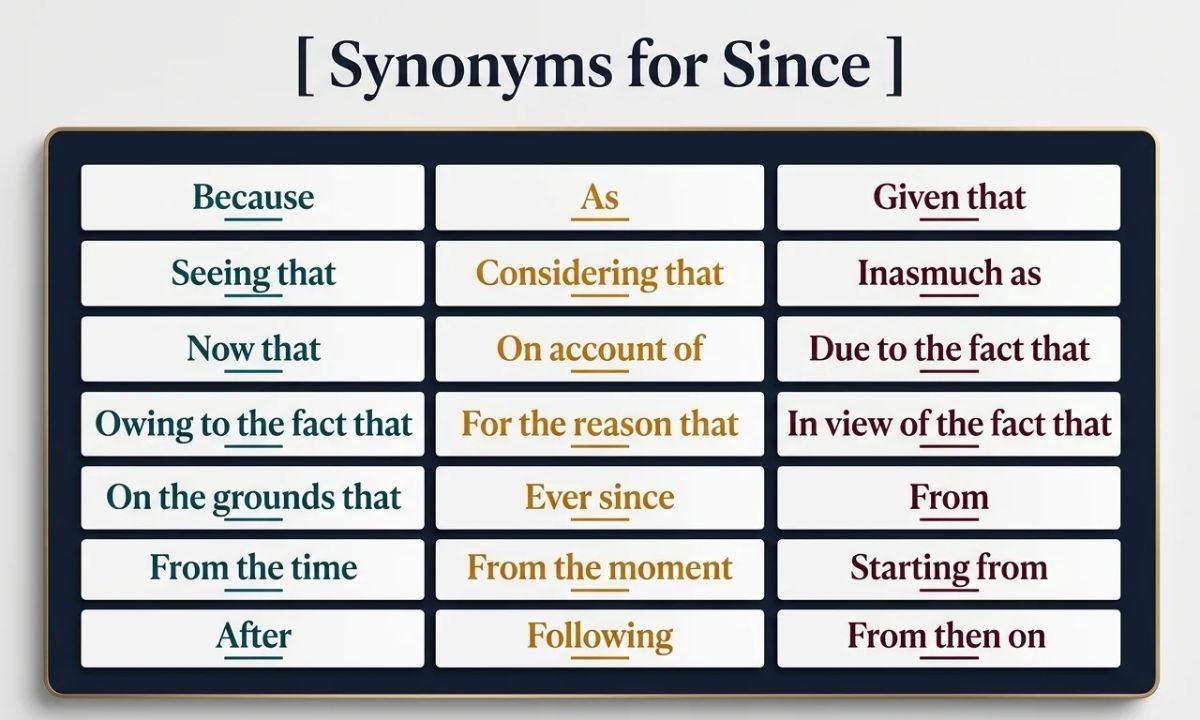
Few small words work as hard as “since.” It points to a time, a reason, or a moment that came after. That flexibility makes it useful and, at times, vague. The right synonym removes the doubt and sharpens your tone. This guide sorts every alternative by meaning, register, and grammar. Use it to choose words that say exactly what you mean.
Quick Answer: Best Synonyms for Since
First, decide what “since” means in your sentence. If it gives a reason, use because, as, given that, or seeing that. If it marks a starting point in time, use from, ever since, or starting from. If it means “after that,” use thereafter, subsequently, or afterward. Match the meaning first, then the formality. Everything else follows from those two choices.
What Does “Since” Mean?
“Since” does three jobs. Each job needs a different replacement.
Since as a conjunction of reason. It means “because” or “in view of the fact that.” Example: Since the office is closed, we will email the files. Here, the clause explains why something happens.
Since as a preposition of time. It means “from a point in the past until now.” Example: She has worked here since 2020. A date or event always follows.
Since as an adverb. It means “after that time” or “ago.” Example: He has since become a manager. Or: That idea was long since forgotten.
Because one word covers all three, readers sometimes stall. A sentence like Since we launched, sales have grown could mean “after we launched” or “because we launched.” When ambiguity creeps in, a synonym is not a luxury. It is a fix.
Since vs. Because, As, and For
Because is the clearest causal word. It is direct and works in any register. Use it when the reason is the main point.
As is softer and more casual. It often hints at circumstance rather than hard cause. As it was raining, we stayed in.
For sounds like an afterthought. It follows the main clause and adds a reason almost as a side note. We stayed in, for it was raining. It reads as literary or formal.
Since sits between them. It introduces a reason the reader already knows or accepts. That is why it often opens a sentence.
Since vs. For: Time and Duration
This is a classic grammar error. Use since with a starting point. Use for with a length of time.
- I have lived here since 2019. (starting point)
- I have lived here for seven years. (duration)
Never write “since seven years.” The present perfect usually pairs with both words. The past simple often replaces it when the action ended: He lived there for five years.
True Synonyms vs. Contextual Alternatives
Not every “synonym” for since is a true synonym. Many are contextual substitutes. They fit one meaning, in one sentence pattern, and nowhere else.
Because, given that, and seeing that replace causal “since” cleanly. They keep the same clause structure.
Due to and because of do not. They need a noun, not a full clause. Because of the delay works. Because of we were late does not. The same goes for owing to, in response to, and as a result of. They suit related sentences but do not preserve the meaning of “since.” Treat them as rewrites, not replacements.
In the lists below, the time words marked as contextual (such as to date or so far) describe the span up to now. They echo the “until now” sense of since, not its starting-point sense.
Grammar, Punctuation, and Clause Placement
A few rules prevent most mistakes.
- Tense: Causal “since” takes any tense. Temporal “since” usually takes the present perfect in the main clause: I have known her since college.
- Verb forms: Since plus a verb ending in -ing is common: Since moving here, I have walked to work.
- Commas: When a since clause opens the sentence, add a comma. When it ends the sentence, a comma is usually optional.
- Agreement: The subject in the since clause must agree with its own verb. Since the results are clear, the team agrees.
- Placement: Put the reason first when it is known. Put it last when it is new information.
Choosing by Context: Email, Academic, and Customer Service
Business email. Use because, given that, or now that. They are polite and direct. Given that the deadline moved, I have updated the plan.
Academic writing. Use inasmuch as, in that, or considering that. They signal precision. Avoid as when it could be read as “while.”
Customer service. Use because and now that. They sound human and calm. Now that your order has shipped, you can track it online.
Tone matters here. A formal word can build authority. A casual word can build rapport. The wrong pick does the opposite.
Synonyms for Since Meaning Because
Use these when the clause gives a reason. Each one keeps the full clause that follows.
Because
Meaning: Reason
Because is the most direct causal conjunction, and it names a cause without hedging. Picture explaining to a colleague why a meeting moved: the reason is the point, so it leads. It adds clarity and removes any chance the reader wonders about your logic.
- Usage Examples:
- We rescheduled the call because two stakeholders were traveling.
- I chose this vendor because their support team responds within an hour.
As
Meaning: Casual reason
As introduces a reason in a light, conversational way, and it can also mean “while,” which makes it riskier than because. Think of a quick note to a teammate: you mention the reason without making it the headline. It keeps the tone relaxed, though you should check that the sentence cannot be read as a time clause.
- Usage Examples:
- As the budget is tight this quarter, we will delay the hiring round.
- As you asked for a summary, I have attached a one-page overview.
Given That
Meaning: Accepted premise
Given that treats the reason as a fact both sides already accept, which is subtler than because. Imagine proposing a change after a clear trend appeared in the data: you build on shared ground. It signals rational structure and invites the reader to follow your logic rather than defend against it.
- Usage Examples:
- Given that demand has doubled, we should add a second shift.
- Given that the contract expires in June, we need a decision this month.
Seeing That
Meaning: Observed reason
Seeing that points to a reason the speaker has just noticed or realized, so it feels responsive and slightly informal. Picture a manager reacting to a missed target in a meeting. It shows attentiveness and frames the next step as a logical reaction rather than a criticism.
- Usage Examples:
- Seeing that the pilot succeeded, we will expand it to all regions.
- Seeing that you are already onsite, could you review the display?
Considering That
Meaning: Weighing facts
Considering that suggests a reason weighed against something else, often an expectation or a limit. Think of praising a result achieved with few resources. It adds fairness and context, and it makes your judgment sound balanced instead of blunt.
- Usage Examples:
- Considering that the team started in March, the progress is remarkable.
- Considering that the system is ten years old, it runs reliably.
Inasmuch As
Meaning: Formal reason
Inasmuch as is a formal conjunction that ties a claim to the extent of its reason, which makes it sound legal or scholarly. A researcher might use it when qualifying a conclusion in a paper. It adds precision and gravity, but overuse makes prose stiff, so save it for formal writing.
- Usage Examples:
- The policy is effective inasmuch as it reduces response times.
- The study is limited inasmuch as it relied on self-reported data.
In View of the Fact That
Meaning: Because of
In view of the fact that is a long, formal way to introduce a reason, and it carries more ceremony than given that. Imagine a board memo explaining a change in direction. It gives the reader a sense of deliberate process, though shorter options often read better in everyday emails.
- Usage Examples:
- In view of the fact that costs have risen, we are revising the proposal.
- In view of the fact that the data is incomplete, we will postpone the vote.
In Light of the Fact That
Meaning: Taking into account
In light of the fact that frames the reason as new information that changes the picture. Think of updating a client after an unexpected supplier delay. It conveys thoughtfulness and shows you adjusted your plan, rather than simply reacting.
- Usage Examples:
- In light of the fact that the venue changed, we have updated the schedule.
- In light of the fact that results improved, we will keep the new process.
Now That
Meaning: Newly true
Now that links a reason to a recent change in circumstances, and it often implies a next step. Picture telling a customer what happens after their account is verified. It builds momentum and feels warm, which is why it suits service writing and friendly emails.
- Usage Examples:
- Now that the data is clean, we can start the analysis.
- Now that you are a member, you can access the full library.
For
Meaning: Added reason
For as a conjunction follows the main clause and adds a reason almost as an afterthought, which gives it a literary, slightly old-fashioned feel. A writer might use it to explain a decision after stating it. It adds rhythm and a measured tone, but it cannot open a sentence the way since can.
- Usage Examples:
- We left early, for the roads were expected to freeze.
- She declined the offer, for she had already committed elsewhere.
Seeing As
Meaning: Informal because
Seeing as is a relaxed, spoken-style conjunction that gives a casual reason. Think of a chat message between coworkers deciding who handles a task. It builds easy rapport, but it can feel too loose for formal documents, so keep it to friendly contexts.
- Usage Examples:
- Seeing as you know the client best, would you lead the call?
- Seeing as it is Friday, let us wrap up early.
On the Grounds That
Meaning: Stated basis
On the grounds that introduces the formal basis for a decision or objection, so it carries a legal or procedural weight. Imagine a committee explaining why it rejected a request. It adds transparency and shows the decision rests on a stated principle, not a whim.
- Usage Examples:
- The request was denied on the grounds that it missed the filing deadline.
- She objected on the grounds that the sample was too small.
In That
Meaning: In which way
In that explains how or in what respect a statement is true, which is narrower than because. A writer might use it to clarify a claim about a product or policy. It adds structural control, since the reader sees exactly which feature justifies the claim.
- Usage Examples:
- The design is efficient in that it uses half the materials.
- The plan is risky in that it depends on a single supplier.
Owing to the Fact That
Meaning: Attributed cause
Owing to the fact that points to a cause that produced a result, and it leans formal and a little wordy. Picture a notice explaining a service interruption. It signals accountability and clear cause-and-effect. Unlike owing to alone, it takes a full clause, so it can replace causal since.
- Usage Examples:
- Owing to the fact that the server failed, orders were delayed.
- Owing to the fact that staffing is low, response times have slipped.
Synonyms for Since Meaning From a Time
Use these when since marks a starting point. Most pair with a date, an event, or a clause.
Ever Since
Meaning: Continuously from
Ever since stresses unbroken continuity from a past event to the present, which plain since only implies. Think of describing a habit that began after a life change. It adds emotional weight and a sense of lasting impact.
- Usage Examples:
- Ever since the merger, our teams have shared one calendar.
- He has run every morning ever since he moved to the coast.
From
Meaning: Starting point
From names the starting point of a period and works best with an explicit date or time. Imagine a notice announcing new office hours. It is short and neutral, and it avoids the tense questions that come with since.
- Usage Examples:
- The new policy applies from January 1.
- Support is available from 8 a.m. on weekdays.
Let it touch you: Synonyms for No: 60 Better Ways to Say No
After
Meaning: Following
After marks a point in time that something follows, and it works as a preposition, conjunction, or adverb. A project manager might use it to sequence tasks. It adds order, though it lacks the “until now” force of since, so it fits completed or future sequences better.
- Usage Examples:
- We changed the process after the audit.
- Sales improved after the new team joined.
Following
Meaning: Coming after
Following is a polished preposition that links a result to an earlier event. Think of a report explaining a trend after a product launch. It sounds professional and neutral, and it keeps the cause-or-time link subtle so you do not overclaim.
- Usage Examples:
- Complaints dropped following the redesign.
- Following the training, error rates fell by a third.
Starting From
Meaning: Beginning at
Starting from marks the first moment of a period or measurement, and it is more explicit than from. Picture a pricing page that begins on a set date. It removes doubt about when a rule or rate begins and works well in instructions.
- Usage Examples:
- Starting from March, all invoices will be digital.
- Starting from the next sprint, we will test every release.
Beginning With
Meaning: Opening point
Beginning with marks the first item in a series or period, so it suits lists, schedules, and timelines. Imagine a manager outlining a rollout by quarter. It gives structure and tells the reader where to start counting.
- Usage Examples:
- Beginning with this issue, the newsletter will arrive weekly.
- Beginning with the 2024 season, the rules are different.
As Of
Meaning: Effective from
As of fixes the date from which a fact or rule holds, and it is a contextual alternative rather than an exact synonym. A finance team might use it in a status report. It adds precision and tells readers when the information was last true.
- Usage Examples:
- As of Monday, the portal accepts digital signatures.
- As of this quarter, we no longer offer the legacy plan.
From the Time That
Meaning: Starting when
From the time that introduces a clause that names the start of a period, which makes it the closest clause-level swap for temporal since. Picture explaining a change after an event. It is formal enough for reports and keeps the timeline clear.
- Usage Examples:
- From the time that she joined, the team has hit every target.
- We have tracked costs from the time that the pilot began.
From the Moment
Meaning: Immediate start
From the moment stresses that a change began instantly, with no gap. Think of a customer story about a product that worked on day one. It adds drama and confidence, so use it when the speed of the shift matters.
- Usage Examples:
- From the moment the update went live, load times improved.
- From the moment we met, we shared the same goals.
Since Then
Meaning: After that
Since then points back to a moment you have just named and describes what has happened from that point until now. A founder might use it to recount growth after a launch. It keeps a story moving and spares you from repeating the date.
- Usage Examples:
- We launched in 2021, and since then, we have added three markets.
- The rules changed in May. Since then, complaints have fallen.
Since That Time
Meaning: Ever after
Since that time is a slightly more formal version of since then. Imagine a history or a case summary describing events after a turning point. It adds gravity and a measured, narrative pace.
- Usage Examples:
- The company restructured in 2019. Since that time, margins have grown.
- He moved abroad in 2015 and has lived there since that time.
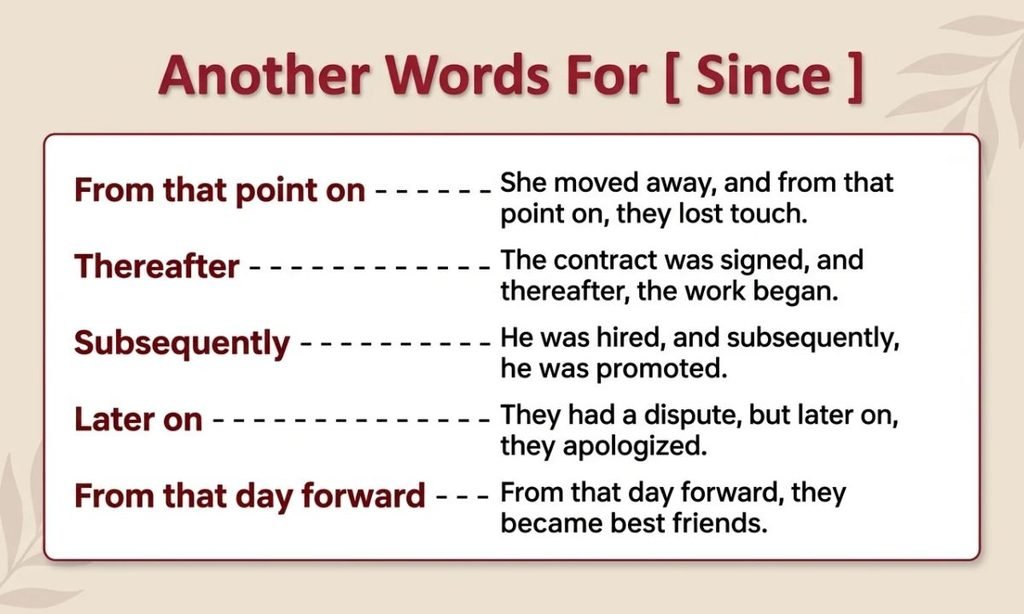
From Then On
Meaning: Continuing onward
From then on describes a change that began at a point and continued afterward, and it often suggests a habit or rule. Picture an anecdote about a lesson learned. It adds a human, story-like feel while still showing lasting effect.
- Usage Examples:
- After the outage, we backed up every file from then on.
- She checked the numbers twice from then on.
Synonyms for Since Meaning After That
Use these when since works as an adverb. They describe what happened later, without a clause after them.
Thereafter
Meaning: Afterward
Thereafter is a formal adverb for “from that time forward.” It fits contracts, reports, and histories more than casual messages. Imagine summarizing a policy change and its consequences. It adds a crisp, authoritative tone and keeps the sentence short.
- Usage Examples:
- The law passed in 2018, and revenue rose thereafter.
- Payment is due on delivery and monthly thereafter.
Subsequently
Meaning: Later
Subsequently marks an event that followed another, and it emphasizes sequence over continuity. A project update might use it to list steps in order. It makes your timeline easy to trace and sounds professional without being stiff.
- Usage Examples:
- The team tested the prototype and subsequently approved it.
- He was subsequently promoted to director.
Afterward
Meaning: Later on
Afterward is a plain, friendly adverb for what came next. Think of describing a meeting and the lunch that followed. It keeps the register relaxed and approachable, which suits emails and narrative writing alike.
- Usage Examples:
- We presented the plan, and afterward, the client asked questions.
- The event ended at noon, and afterward, we shared notes.
You will love: Synonyms for Especially: 30 Precise Alternatives With Examples
Ago
Meaning: In the past
Ago counts backward from now, so it replaces the adverbial “long since” sense, not the starting-point sense. A sentence about an old habit is a good home for it. It adds clean distance in time and avoids tense confusion.
- Usage Examples:
- We started this project three years ago.
- That policy ended long ago.
Long Since
Meaning: Long ago
Long since is the adverbial form that means something happened a long time before now and remains in effect. A writer might use it to describe a forgotten rule. It adds a quiet, literary finality and suits polished prose.
- Usage Examples:
- The old system was long since retired.
- Those concerns have long since been addressed.
Already
Meaning: By now
Already replaces the “since” that signals something happened earlier than expected, and it is a contextual substitute. Think of updating a manager on tasks that are done. It conveys progress and signals that no further action is needed.
- Usage Examples:
- The files have already been sent to the client.
- She has already completed the training.
Contextual Alternatives for the “Until Now” Sense
These words echo the span from a past point up to the present. They are contextual substitutes, so check the meaning before you swap.
Until Now
Meaning: Up to present
Until now stresses that something held true up to this moment, with the implication that it may change. Picture a status update that marks a turning point. It adds contrast and prepares the reader for what comes next.
- Usage Examples:
- Until now, the team has handled requests manually.
- Until now, no one had questioned the process.
Up to Now
Meaning: Thus far
Up to now is a conversational way to describe the period before the present. It works in meetings and updates alike. It feels natural and honest, since it invites the listener to expect more.
- Usage Examples:
- Up to now, we have received twelve applications.
- Up to now, the pilot has run without incident.
To Date
Meaning: So far
To date is a compact, formal phrase common in business reports and metrics. A project summary might use it to state a total. It adds a professional, data-driven tone and keeps long sentences tidy.
- Usage Examples:
- To date, we have trained 400 employees.
- The campaign has raised $1.2 million to date.
So Far
Meaning: Up to now
So far is the casual cousin of to date, and it suggests the story is not finished. Think of a check-in with a client mid-project. It builds trust by sounding open and unfinished, which is helpful in progress updates.
- Usage Examples:
- So far, the feedback has been positive.
- So far, we have met every milestone.
Thus Far
Meaning: Until here
Thus far is a slightly formal alternative to so far. It fits reports, presentations, and thoughtful emails. It adds a measured, composed tone and signals that you are summing up before moving on.
- Usage Examples:
- Our results thus far support the hypothesis.
- The review has uncovered no major issues thus far.
Hitherto
Meaning: Until this time
Hitherto is a rare, formal adverb for “up to this point,” and it carries an old-fashioned, scholarly feel. An academic might use it to mark a shift in research. It adds weight and sophistication, but it can sound distant in modern business writing.
- Usage Examples:
- The study revealed a hitherto unknown pattern.
- Hitherto, the field had relied on small samples.
Frequently Asked Questions About Synonyms for Since
What is another word for since?
The best replacement depends on meaning, so use because for reasons, from or ever since for time, and thereafter for “after that.”
Can because replace since?
Yes, because replaces causal since in nearly every sentence, but it cannot replace since when the word marks a starting point in time.
Is since formal or informal?
Since is neutral and works in both settings, though inasmuch as sounds more formal and as or seeing as sounds more casual.
What is the difference between since and ever since?
Since marks a past starting point, while ever since stresses that the situation has continued without a break up to now.
Can due to replace since?
No, because due to needs a noun phrase and cannot introduce the full clause that since introduces.
Conclusion
The right word does more than fill a gap: it tells the reader whether you mean time or reason, shapes how formal and confident you sound, and removes the small friction that makes a sentence harder to trust. When you replace “since” with because, ever since, or thereafter, you give your logic a clean structure and your tone a deliberate shape. Choose by meaning first, register second, and the sentence will carry both clarity and calm.

Hi, my name is Kalvin. I love to read and learn new words every day. On this site, I share easy synonyms and simple grammar tips. Let us learn and write better together!


One thought on “Synonyms for Since: 38 Clear Alternatives for Time and Reason”