
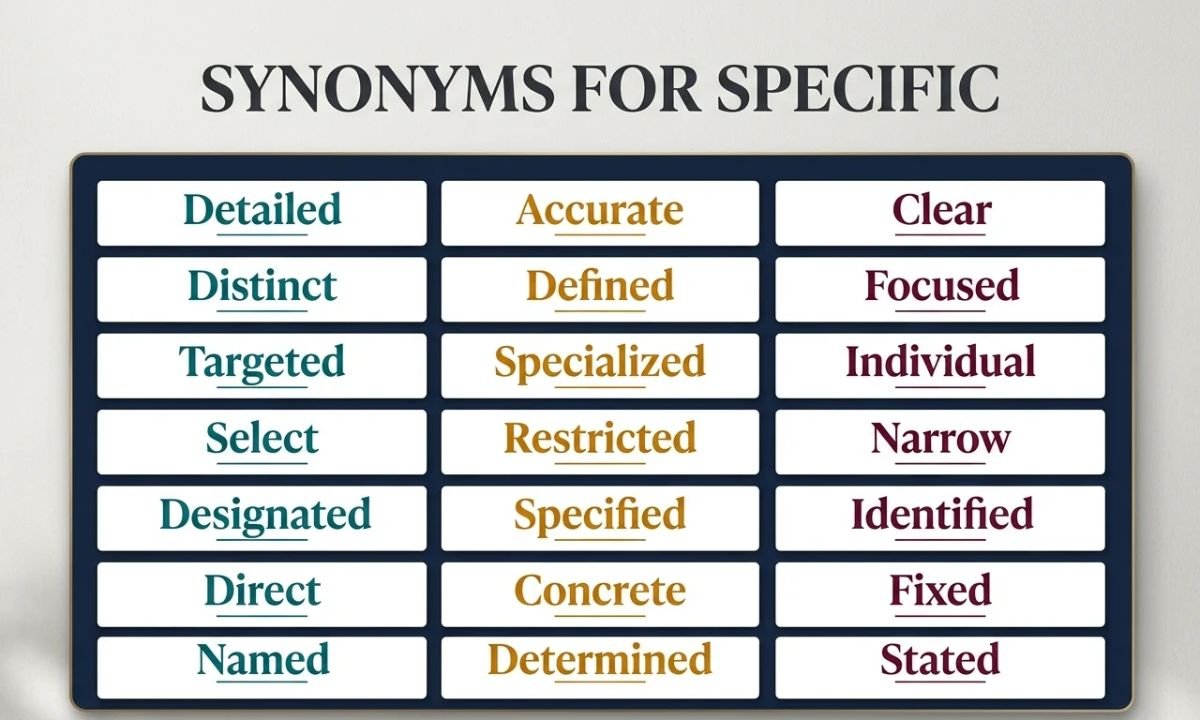
Vague words cost you time, trust, and clarity. When you say “be more specific,” you ask for precision, yet “specific” itself is a word we overuse. The right replacement sharpens your meaning and fits your audience. This guide gives you 35 alternatives, grouped by nuance, tone, and real-world use. Each one comes with a short explanation and two natural examples. Pick the word that matches your sentence, not the one that merely sounds impressive.
What Is Another Word for Specific?
The most common another word for specific is particular, precise, or exact. Each carries a different shade. Particular points to one item, precise stresses accuracy, and exact demands no margin for error. Words for specific also include explicit, definite, concrete, and detailed, so the best choice depends on what you want to stress.
What Does Specific Mean?
Specific means clearly defined, limited to one thing, or stated in full detail. Dictionaries list three core senses: particular or definite, precise and exact, and clearly expressed. Most synonyms for specific cover only one of these senses, which is why a single “best synonym for specific” does not exist.
Specific as an Adjective and a Noun
Most people use specific as an adjective: “a specific date,” “specific instructions.” It also works as a noun in the plural. Specifics means details or facts: “Send me the specifics.” Adjective synonyms such as exact or explicit will not replace the noun. For “specifics,” use details, particulars, or facts.
Specific vs. General: Key Difference
Specific narrows a statement to one case. General covers a broad group. “Improve sales” is general. “Raise repeat orders by 10% this quarter” is specific. Common antonyms of specific include general, vague, broad, indefinite, ambiguous, nonspecific, and imprecise.
Formal vs. Informal Synonyms for Specific
Register matters. Formal synonyms for specific include stipulated, categorical, unambiguous, and designated. They suit contracts, reports, and academic writing. Everyday speech prefers plain choices such as exact, particular, set, or clear-cut. Match the word to your reader, and your writing sounds natural.
How to Choose the Right Synonym
Ask three questions. First, do you mean accuracy (precise, exact)? Second, do you mean one item among many (particular, individual)? Third, do you mean fully stated (explicit, detailed)? Match the meaning, check the register, then read the sentence aloud. If it sounds forced, choose a simpler word. The 35 alternatives below follow this logic.
Exact
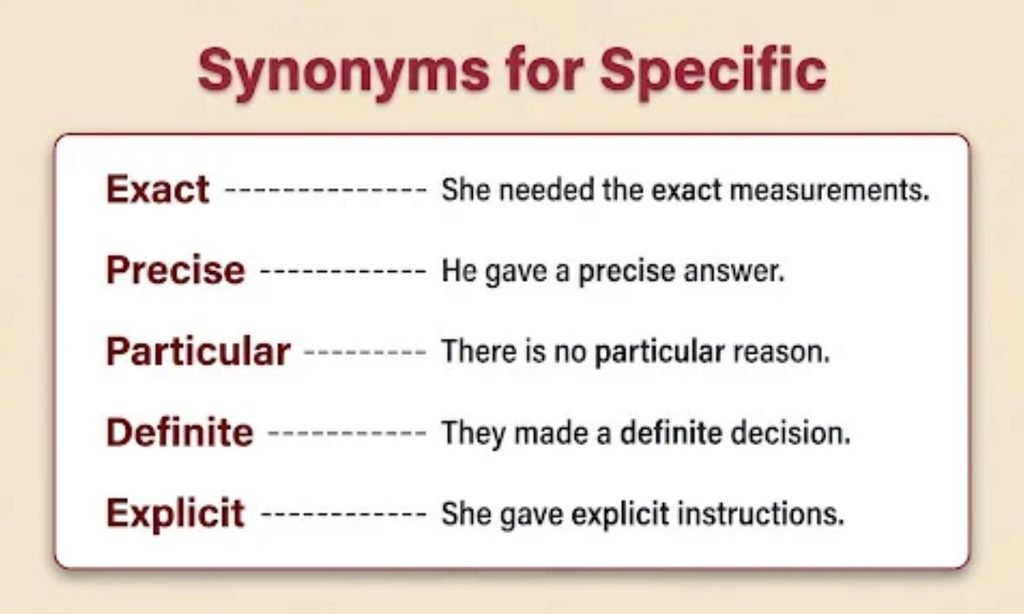
Context & Usage: Exact means correct in every detail, with no room for approximation. It fits measurements, times, amounts, and quotes, and it signals that you value accuracy. Use it in daily speech when someone needs the number or fact, not a rough guess.
Examples:
- Please give me the exact address before I leave.
- The exact amount owed is $42.10.
Precise
Context & Usage: Precise describes careful, accurate detail, often in science, engineering, or finance. It differs slightly from specific: a statement can be specific without being precise. It tells your reader you took care, which builds trust.
Examples:
- The chef followed a precise recipe down to the gram.
- She gave a precise account of what happened.
Particular
Context & Usage: Particular points to one individual item or case within a group. It suits conversation, preferences, and analysis, and it often adds a slight emphasis. In the specific vs. particular debate, particular stresses the single item, while specific stresses the defining detail.
Examples:
- Is there a particular book you want me to find?
- He is particular about how his coffee is made.
Explicit
Context & Usage: Explicit means stated openly, leaving nothing to guesswork. It works well for rules, instructions, and agreements. It conveys honesty and clarity, and it removes the chance of misunderstanding.
Examples:
- The contract gives explicit instructions for cancellation.
- She was explicit about what she needed from the team.
Definite
Context & Usage: Definite means fixed, settled, and clear in outline. Use it for plans, answers, and decisions that need certainty. It brings reassurance because the listener knows where things stand.
Examples:
- We need a definite answer by Friday.
- There is no definite plan for the trip yet.
Concrete
Context & Usage: Concrete describes ideas backed by real, tangible detail instead of theory. It shines in feedback, proposals, and problem-solving. It gives the reader something they can act on.
Examples:
- Can you offer a concrete example of the problem?
- The manager asked for concrete steps, not general goals.
Distinct
Context & Usage: Distinct means clearly different or easy to tell apart. Use it when a feature, sound, or idea stands out from the rest. It adds a sense of clarity and individual identity.
Examples:
- Each team has a distinct role in the launch.
- The soup has a distinct flavor of smoked paprika.
Detailed
Context & Usage: Detailed means containing many fine points. It is not an exact match for specific: a detailed report can still be vague on key facts. Choose it when the reader expects depth and thoroughness.
Examples:
- Please send a detailed summary of the meeting.
- The map offers detailed directions to the venue.
Specified
Context & Usage: Specified means named or set out in advance. It belongs in business, legal, and technical settings. It signals that the rule or value was agreed ahead of time.
Examples:
- Deliver the goods by the specified date.
- Use only the specified materials.
Well-Defined
Context & Usage: Well-defined describes something with clear limits and a clear purpose. It suits project goals, roles, and scope statements. It gives teams confidence because everyone sees the same boundaries.
Examples:
- The project has a well-defined scope.
- Each job title comes with well-defined duties.
Unambiguous
Context & Usage: Unambiguous means open to only one reading. It is a formal choice for policies, safety notices, and legal text. It shows that you care about being understood the first time.
Examples:
- The warning label must be unambiguous.
- Her reply was short and unambiguous.
Categorical
Context & Usage: Categorical means stated absolutely, with no conditions. It is formal and strong, so use it sparingly. It conveys firm conviction, which can sound blunt in casual speech.
Examples:
- The minister gave a categorical denial.
- He made a categorical statement about the policy.
Designated
Context & Usage: Designated means formally chosen for a purpose or place. It fits times, areas, roles, and people. It brings order and shows that the choice was intentional.
Examples:
- Park in the designated area only.
- A designated person will greet each guest.
Stipulated
Context & Usage: Stipulated means required or set as a condition in an agreement. It is a formal word for requirements, terms, and conditions. It signals that the detail is binding, not optional.
Examples:
- Payment must arrive by the stipulated deadline.
- The lease lists the stipulated conditions.
Prescribed
Context & Usage: Prescribed means laid down as a rule or method to follow. It suits regulations, procedures, and official forms. It reminds the reader that the standard is set, not negotiable.
Examples:
- Submit the form in the prescribed format.
- The nurse followed the prescribed procedure.
Individual
Context & Usage: Individual refers to one member of a group, considered on its own. Use it when you separate a single case from the whole. It adds a personal, focused tone.
Examples:
- Each individual request will get a reply.
- The report lists individual scores for every student.
Express
Context & Usage: Express means clearly and directly stated, often tied to a purpose or wish. It fits formal and legal language, as in “express permission.” It conveys intention and removes doubt.
Examples:
- He left with the express purpose of finding help.
- You need express consent to share this file.
Clear-Cut
Context & Usage: Clear-cut means plain, sharply defined, and easy to judge. It works in everyday and professional talk. It brings relief because the situation has no gray areas.
Examples:
- The rules are clear-cut and easy to follow.
- This is not a clear-cut case.
Unequivocal
Context & Usage: Unequivocal means leaving no doubt at all. It is formal and strong, suited to statements, evidence, and commitments. It shows full confidence in what you say.
Examples:
- The board gave unequivocal support to the plan.
- Her answer was an unequivocal yes.
Fixed
Context & Usage: Fixed means set and not open to change. Use it for dates, prices, schedules, and rates. It gives stability, so people can plan with confidence.
Examples:
- The class meets at a fixed time each week.
- We offer a fixed price for the whole job.
Set
Context & Usage: Set is a short, informal way to say decided in advance. It suits casual talk about times, amounts, and rules. Its plain tone keeps your message relaxed but clear.
Examples:
- Is there a set time for lunch?
- They have a set routine every morning.
Special
Context & Usage: Special points to something with its own purpose or identity, apart from the usual. Use it for tools, requests, or occasions. It adds warmth and a sense of value.
Examples:
- This lock needs a special key.
- I made a special request for a quiet room.
Singular
Context & Usage: Singular means one of a kind or standing alone. It suits writing that stresses uniqueness. Use it carefully, because it can sound formal or literary.
Examples:
- She has a singular focus on quality.
- The report found a singular cause for the delay.
Targeted
Context & Usage: Targeted means aimed at a defined group or goal. It is common in marketing, health, and strategy. It is a contextual substitute, not a direct synonym, so use it only when aim is the point.
Examples:
- The campaign uses targeted messages for new parents.
- We launched a targeted program for small shops.
Tailored
Context & Usage: Tailored means adapted to fit a person or need. It suits services, plans, and advice. It carries a caring tone because it implies the effort was made for the reader.
Examples:
- She wrote a tailored plan for each client.
- The course offers tailored feedback.
Specialized
Context & Usage: Specialized describes something built or trained for a narrow field. It fits skills, tools, and services. It signals expertise and focus.
Examples:
- The job needs specialized training.
- He uses specialized software for audio work.
Named
Context & Usage: Named means identified by name, which makes a reference exact. It works in forms, contracts, and daily talk. It removes confusion about who or what you mean.
Examples:
- Only the named guests may enter.
- Please send it to the named contact.
Also Read: Synonyms of Resilience: 30 Precise Words and Examples
Defined
Context & Usage: Defined means clearly outlined and bounded. It is simpler than well-defined and works in most settings. It suggests the topic has been thought through.
Examples:
- Each task has a defined owner.
- Set a defined budget before you begin.
Itemized
Context & Usage: Itemized means listed point by point. It fits bills, budgets, and reports. It builds trust because the reader can check every line.
Examples:
- Please attach an itemized receipt.
- The quote includes an itemized list of costs.
Granular
Context & Usage: Granular means broken down to fine levels of detail. It is common in data, planning, and analysis. It tells the reader you looked closely at the small parts.
Examples:
- The dashboard shows granular sales data by store.
- We need granular feedback on each step.
Accurate
Context & Usage: Accurate means correct and free from error. It overlaps with specific only when the point is correctness. Use it when the reader cares about truth more than detail.
Examples:
- Give an accurate count of the guests.
- The report offers an accurate picture of events.
Pinpoint
Context & Usage: Pinpoint, used as an adjective, means exact and tightly aimed. It is lively and works in casual and professional speech. It adds energy and a sense of sharp focus.
Examples:
- The GPS gave pinpoint directions.
- She offered pinpoint advice on the problem.
Dedicated
Context & Usage: Dedicated means set aside for one purpose. It is a contextual substitute that fits tools, spaces, and teams. Use it when exclusive purpose is the key idea.
Examples:
- We have a dedicated room for meetings.
- The firm hired a dedicated support agent.
Scheduled
Context & Usage: Scheduled works as another word for specific time, because it ties an event to a planned moment. It fits meetings, flights, and deadlines. It brings order and sets expectations.
Examples:
- The scheduled call starts at noon.
- Our scheduled visit is on Monday.
Certain
Context & Usage: Certain, before a noun, points to something particular without naming it. It is a gentle, polite choice in everyday talk. It keeps your tone relaxed while still narrowing the meaning.
Examples:
- Certain items are not available online.
- Only certain people can approve the change.
Specific vs. Precise, Exact, and Particular
Precise stresses accuracy. Exact stresses a perfect match. Particular stresses one chosen item. Specific sits between them and means clearly defined. So “a precise time” means to the minute, “a particular time” means one chosen time, and “a specific time” means a time you have clearly named. Use explicit when the point is that something is stated openly, and detailed when the point is depth.
Common Mistakes When Replacing Specific
Treating every synonym as interchangeable. “A detailed question” is not the same as “a specific question.” Choosing a formal word in casual writing. “Stipulated” feels heavy in a friendly email. Using contextual words as direct synonyms. Tailored, targeted, relevant, and dedicated only fit when that exact meaning applies. Repeating the same substitute. Vary your word choice, or rewrite the sentence with a concrete detail instead.
Frequently Asked Questions
What is a stronger word than specific?
Unequivocal, categorical, and precise are stronger, depending on whether you mean certainty or accuracy.
What is the formal synonym of specific?
Explicit, unambiguous, designated, and stipulated are the most common formal synonyms.
What synonym is best for essays?
Use precise, explicit, or well-defined, because they sound academic and keep your claims clear.
What synonym is best for business writing?
Use defined, concrete, or specified, since they sound professional and point to actionable detail.
Can specific and particular be used interchangeably?
Often yes, but particular stresses one item in a group, while specific stresses a clearly defined detail.
Conclusion
Choosing the right alternative to specific turns a vague sentence into a clear, confident one. When you match meaning, register, and context, your readers understand you faster and trust your words more. Keep this list close, test each word in a real sentence, and let precision become a habit that strengthens every message you write.

Hi, my name is Kalvin. I love to read and learn new words every day. On this site, I share easy synonyms and simple grammar tips. Let us learn and write better together!

3 thoughts on “Synonyms for Specific: 35 Better Words With Examples”