
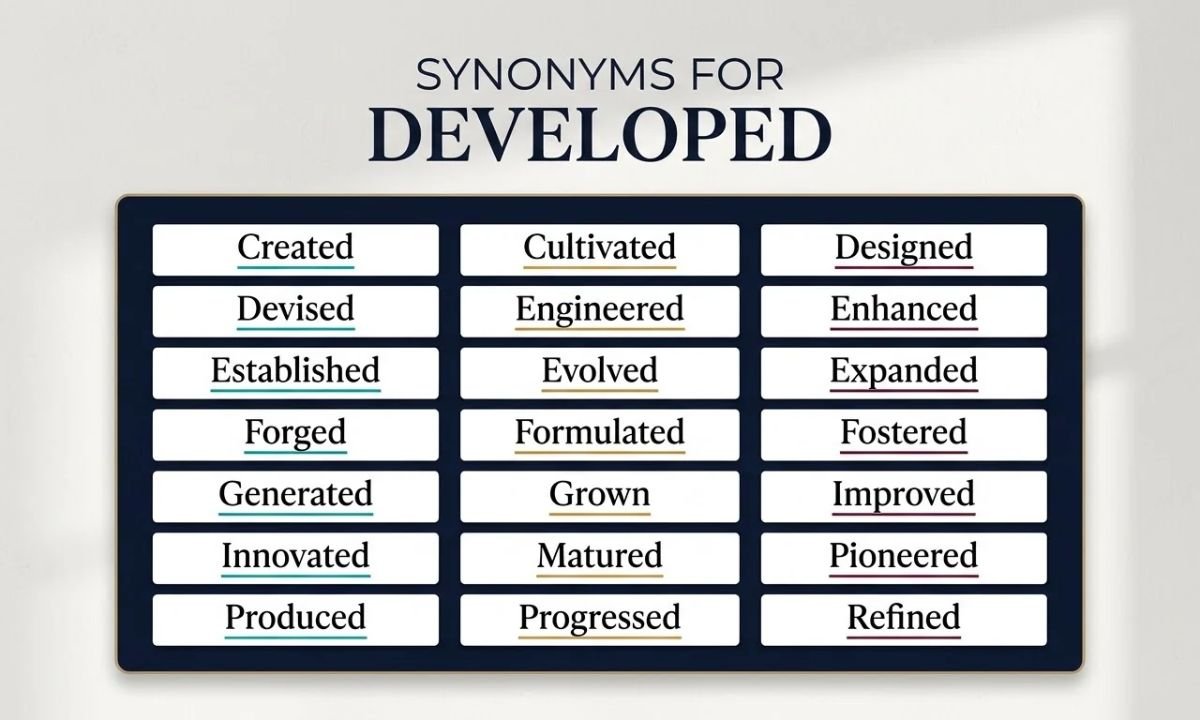
Word choice shapes how people read you before they decide what you mean. “Developed” is a useful word, but it is also a vague one, and it shows up in resumes, essays, and emails more often than it should. Swapping it for the right term makes a sentence sharper and a claim easier to believe. This guide gives you 60 synonyms for developed, sorted by what you are actually trying to say. You will see where each one fits, where it breaks, and how it sounds in a real sentence. Pick the word that matches your meaning, and the rest of your writing gets easier.
What “Developed” Means, and Why It Gets Overused
“Developed” does several jobs at once. As a verb, it can mean to create something, to grow something, or to acquire something, like a skill or an illness. As an adjective, it describes something advanced or fully formed.
That range is the problem. “I developed a new process” does not tell the reader whether you designed it, tested it, or simply ran it. The best synonyms of developed carry the detail the original word leaves out.
Developed as a Verb vs. an Adjective
Start by deciding which kind of word you need, because the two lists do not mix. Verb synonyms include created, built, evolved, and acquired. Adjective synonyms include advanced, mature, industrialized, and full-grown.
Here is a quick test. If you can put “very” in front of the word, it is working as an adjective, as in “a very developed economy.” If it has an object or follows “has” or “have,” it is a verb, as in “she developed a plan.” You can write “she drafted a plan,” but you cannot write “a drafted country.”
Another Word for Developed: How to Choose the Right One
Before you reach for a synonym for develop or developed, ask three questions. What did you actually do? How much of it was yours? What was the result?
Match the word to your level of ownership. “Spearheaded” suggests you led. “Engineered” suggests technical design. “Supported” is the honest choice when you helped someone else’s project. A good alternative is always more specific than the word it replaces.
Grammar Traps When You Replace Developed
Some swaps break the sentence. “Developed” works with or without an object: “she developed a rash” and “the plot developed slowly” are both fine. Words like evolved, matured, and progressed usually take no object, so “we evolved the strategy” sounds off in most business writing.
Prepositions shift too. Things develop, evolve, grow, and mature “into” something, and they come “from” somewhere. Also watch the difference between developed and evolved. Developed often implies deliberate effort. Evolved implies gradual change that no single person directed.
Words to Replace Developed on a Resume
Career writers often suggest that a synonym alone will lift a resume past hiring software. That claim is shaky. Applicant tracking systems mostly look for the skills and terms in the job post, so use the post’s own wording wherever it is true.
What a stronger verb does give you is clarity for the human reader. Pair it with scope and a result. Tone matters as well: “coded” can read as junior, while “built,” “engineered,” and “shipped” read as more senior. Never claim ownership you did not have. If you assisted, write “supported.”
Specialist Meanings Most Lists Skip
“Developed” has uses outside business writing, and each one has its own alternatives.
- Medical: “She developed a fever” can become “she contracted an infection,” “she came down with a fever,” or “symptoms manifested.”
- Geopolitical: “Developed countries” is common but can sound like a ranking. Many writers prefer “high-income,” “industrialized,” or “advanced economies.”
- Photography: Film is not developed so much as processed, and an image is printed.
- Real estate: Land is developed when it is built on, improved, subdivided, or urbanized.
1. Created
Context & Usage: Created means you brought something into existence that was not there before. It fits whenever you want a plain, neutral verb for a new thing. It claims ownership without sounding inflated.
Examples:
- She created a weekly report that replaced three separate spreadsheets.
- We created a simple onboarding checklist for new hires.
2. Built
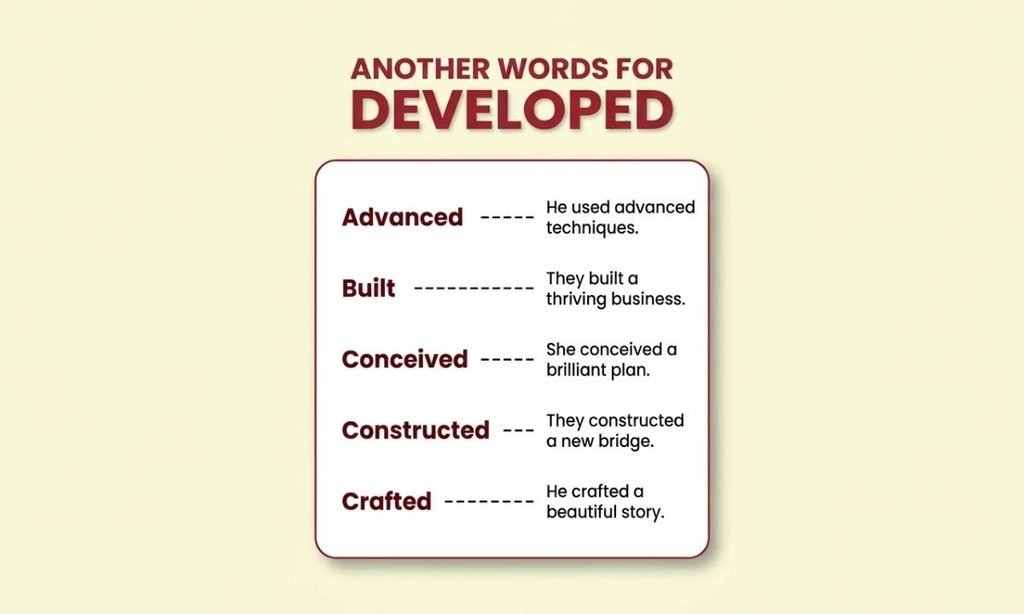
Context & Usage: Built suggests you made something piece by piece through real effort. It works for software, teams, products, and habits. Readers tend to trust it because it sounds solid and hands-on.
Examples:
- He built the booking tool from scratch in six weeks.
- They built a loyal customer base through honest service.
3. Established
Context & Usage: Established means you set something up so that it lasts. It fits systems, rules, programs, and relationships. The word carries authority and a sense of permanence.
Examples:
- The firm established a mentoring program for junior staff.
- She established clear rules for how the team shares files.
4. Engineered
Context & Usage: Engineered points to careful technical design where the parts work together. It suits tech, manufacturing, and process work. It sounds odd for soft topics like ideas or friendships, so keep it technical.
Examples:
- The team engineered a cooling system that cut energy use.
- He engineered the data pipeline to handle ten times the traffic.
5. Designed
Context & Usage: Designed means you planned the form and function of something before making it. It fits products, layouts, courses, and workflows. It shows thought and intent behind the result.
Examples:
- She designed a training course for new managers.
- We designed the form so customers can finish it in two minutes.
6. Devised
Context & Usage: Devised means you thought up a plan or method, usually to solve a problem. It fits strategies, workarounds, and clever fixes. It adds a note of quick, creative thinking.
Examples:
- He devised a simple system for tracking late invoices.
- The coach devised a drill to fix the team’s passing.
7. Formulated
Context & Usage: Formulated means you put an idea or plan together carefully and in precise terms. It fits strategies, theories, hypotheses, and recipes. It makes you sound methodical rather than rushed.
Examples:
- The committee formulated a response to the new rules.
- She formulated a hypothesis and tested it over three months.
8. Crafted
Context & Usage: Crafted implies skilled, careful work, often with words, messages, or goods. It fits writing, branding, and handmade products. It adds warmth and pride, but it feels too grand for routine tasks.
Examples:
- He crafted a short, direct email that got a reply within the hour.
- The studio crafted a brand voice that felt friendly and clear.
9. Pioneered
Context & Usage: Pioneered means you were among the first to do something. Use it only when it is true, because it is a big claim. It signals vision and nerve.
Examples:
- Her lab pioneered a faster way to test water quality.
- The company pioneered flexible hours in its industry.
10. Spearheaded
Context & Usage: Spearheaded means you led an effort from the front. It fits initiatives, campaigns, and projects you personally drove. It signals leadership, but it overreaches if you were one of many contributors.
Examples:
- She spearheaded the move to a new payroll system.
- He spearheaded a food drive for the local shelter.
11. Launched
Context & Usage: Launched focuses on the moment something goes out into the world. It fits products, campaigns, and new businesses. It carries energy and momentum.
Examples:
- The team launched the new app in March.
- She launched a newsletter for local small business owners.
You will love this: Synonyms for Specific: 35 Better Words With Examples
12. Implemented
Context & Usage: Implemented means you put a plan into action, even if someone else designed it. It fits policies, software rollouts, and process changes. It shows follow-through, which managers value.
Examples:
- We implemented the new filing system across all offices.
- He implemented the safety changes ahead of schedule.
13. Orchestrated
Context & Usage: Orchestrated means you coordinated many people or parts toward one outcome. It fits events, rollouts, and projects that cross teams. It suggests calm, skilled management of moving pieces.
Examples:
- She orchestrated a product launch across four time zones.
- The manager orchestrated the handoff between sales and support.
14. Architected
Context & Usage: Architected means you designed the overall structure of a system, usually a technical one. It fits software and infrastructure work. Outside tech it can sound stiff, so use it with the right audience.
Examples:
- He architected the platform to support future growth.
- She architected a storage setup that kept costs flat.
15. Shipped
Context & Usage: Shipped is tech slang for releasing finished work to users. It fits software and product teams. It sounds casual and confident, and it proves the work reached real people.
Examples:
- The team shipped the redesign two weeks early.
- She shipped three features in her first quarter.
16. Optimized
Context & Usage: Optimized means you made something work as well as it can. It fits processes, pages, and systems that already existed. Back it up with a measure, or the word turns into filler.
Examples:
- He optimized the checkout page, and more visitors finished their orders.
- They optimized delivery routes to save fuel.
17. Streamlined
Context & Usage: Streamlined means you simplified a process by cutting steps or waste. It fits workflows, forms, and meetings. It promises less hassle, which readers like.
Examples:
- She streamlined the approval process from five steps to two.
- We streamlined our weekly meeting to twenty minutes.
18. Refined
Context & Usage: Refined means you improved something through small, careful changes. It fits ideas, drafts, recipes, and methods. It suggests patience and polish rather than a big overhaul.
Examples:
- He refined the pitch after each client meeting.
- The chef refined the sauce over several weeks.
19. Enhanced
Context & Usage: Enhanced means you raised the quality or value of something that already existed. It fits features, services, and skills. It is a mild, general word, so say exactly what got better.
Examples:
- The update enhanced search so results load faster.
- She enhanced the course with real client examples.
20. Expanded
Context & Usage: Expanded means you made something bigger in size or reach. It fits businesses, programs, and knowledge. It signals growth, but it says nothing about quality.
Examples:
- The bakery expanded to a second location last spring.
- He expanded the program to include evening classes.
21. Grew
Context & Usage: Grew is the plain, human word for increasing in size or strength. It works for businesses, teams, audiences, and people. It sounds natural and avoids corporate stiffness.
Examples:
- She grew her newsletter from a few hundred readers to several thousand.
- The startup grew faster than anyone expected.
22. Advanced
Context & Usage: As a verb, advanced means to move something forward. As an adjective, it describes something more highly developed than the usual. It fits science, skills, and technology.
Examples:
- The lab advanced the study of soil bacteria.
- It is an advanced economy with strong exports.
23. Progressed
Context & Usage: Progressed means something moved forward step by step over time. It takes no object, so you cannot progress a plan. It fits projects, learners, and illnesses.
Examples:
- The project progressed well after the redesign.
- Her Spanish progressed quickly during the year abroad.
24. Evolved
Context & Usage: Evolved means something changed gradually into a different form. It implies slow change that no single person directed. It is the wrong choice when you deliberately built the thing, and it pairs with “into” or “from.”
Examples:
- The small shop evolved into a regional chain.
- Our process evolved as the team learned what worked.
25. Matured
Context & Usage: Matured means something reached a fuller, steadier state. It fits people, markets, and ideas. It suggests wisdom and stability rather than speed.
Examples:
- The market matured as larger players joined.
- He matured a great deal after his first year managing a team.
26. Cultivated
Context & Usage: Cultivated means you grew something with steady, patient care, such as a skill, a relationship, or a habit. It fits long-term effort. It signals that the result took time, which makes it feel earned.
Examples:
- She cultivated relationships with local suppliers over many years.
- He cultivated a habit of writing for ten minutes each morning.
27. Fostered
Context & Usage: Fostered means you encouraged something to grow, often in other people or in an environment. It fits culture, trust, and curiosity. It shows support instead of control.
Examples:
- The teacher fostered a classroom where students felt safe asking questions.
- Our manager fostered trust by sharing mistakes openly.
28. Nurtured
Context & Usage: Nurtured is a warmer cousin of fostered. It means you cared for something while it grew. It suits talent, ideas, and early-stage relationships, and it carries real emotional weight.
Examples:
- She nurtured young writers through their first drafts.
- He nurtured the idea until it was ready for a pilot.
29. Honed
Context & Usage: Honed means you sharpened a skill through repeated practice. It fits craft, public speaking, and technique. It signals deliberate effort, not natural talent.
Examples:
- She honed her negotiation skills through years of vendor talks.
- He honed the speech until it fit in five minutes.
Beauty on every page: Synonyms for Since: 38 Clear Alternatives for Time and Reason
30. Sharpened
Context & Usage: Sharpened is the plainer cousin of honed. It means you made a skill or idea clearer and more effective. It fits arguments, focus, and instincts, and everyone understands it at once.
Examples:
- The debate club sharpened her argument skills.
- A tight deadline sharpened the team’s focus.
31. Mastered
Context & Usage: Mastered means you reached a high level of skill and can do the thing with confidence. It fits crafts, languages, and tools. It is a strong claim, so make sure others would agree with it.
Examples:
- She mastered the spreadsheet software within a few months.
- He mastered the art of the short, clear report.
32. Strengthened
Context & Usage: Strengthened means you made something more solid or reliable. It fits skills, teams, relationships, and arguments. It suggests the thing was already there and now holds up better.
Examples:
- The new hire strengthened our support team.
- She strengthened the report by adding customer data.
33. Accelerated
Context & Usage: Accelerated means you made something happen faster. It fits growth, learning, and timelines. It speaks to speed, not direction, so pair it with a clear goal.
Examples:
- The new tool accelerated our testing cycle.
- Daily practice accelerated his progress.
34. Transformed
Context & Usage: Transformed means you changed something completely, not just slightly. It fits turnarounds, renovations, and major shifts. Save it for real change, because readers notice when it is overused.
Examples:
- The renovation transformed the old warehouse into office space.
- She transformed a confusing intake form into a one-page checklist.
35. Elaborated
Context & Usage: Elaborated means you added detail to an idea that already existed. It fits explanations, arguments, and plans. It works well in essays and reports where depth matters.
Examples:
- The author elaborated her theory in the second chapter.
- He elaborated on the plan after the board asked questions.
36. Articulated
Context & Usage: Articulated means you put an idea into clear words. It fits values, visions, and complex arguments. It signals that you made something fuzzy easy to understand.
Examples:
- She articulated the company’s goals on a single page.
- He articulated why the old design had failed.
37. Conceptualized
Context & Usage: Conceptualized means you formed an idea in your mind before anything was built. It fits early planning in marketing, design, and strategy. It can sound heavy, so use it sparingly and only where the idea stage matters.
Examples:
- The team conceptualized the campaign during a weekend workshop.
- She conceptualized a simpler pricing model.
38. Drafted
Context & Usage: Drafted means you wrote or sketched a first version. It fits documents, policies, contracts, and plans. It is honest about the stage of the work, which readers appreciate.
Examples:
- He drafted the policy and sent it to legal.
- She drafted three versions of the proposal.
39. Mapped
Context & Usage: Mapped means you laid out a process, journey, or plan in detail. It fits systems, strategies, and customer paths. It suggests you saw the whole picture and put it on paper.
Examples:
- She mapped the customer journey from first click to delivery.
- The team mapped each step of the hiring process.
40. Prototyped
Context & Usage: Prototyped means you built an early version to test an idea. It fits products, apps, and layouts. It shows a test-and-learn habit and keeps you from overselling unfinished work.
Examples:
- He prototyped the app in a weekend.
- The team prototyped three layouts before choosing one.
41. Produced
Context & Usage: Produced means you made something as an output, whether goods, content, or results. It fits manufacturing, media, and research. It is neutral and factual, with little emotion attached.
Examples:
- The studio produced twelve training videos.
- Her research produced a clearer picture of customer needs.
42. Generated
Context & Usage: Generated means you caused something to come into being, often leads, revenue, or ideas. It fits results you can measure. It sounds mechanical, so it is a weak choice for creative work.
Examples:
- The campaign generated hundreds of new leads.
- She generated ideas by interviewing customers.
43. Constructed
Context & Usage: Constructed means you built something with a clear structure, whether physical or abstract. It fits buildings, frameworks, and arguments. The tone is formal, which suits reports and essays.
Examples:
- The crew constructed the footbridge in a month.
- He constructed a clear argument from three case studies.
44. Assembled
Context & Usage: Assembled means you brought parts or people together into one whole. It fits teams, kits, reports, and collections. It highlights organization more than invention.
Examples:
- She assembled a team of five engineers.
- He assembled the report from data in four departments.
45. Fashioned
Context & Usage: Fashioned means you made something with skill, often by hand or from rough material. It fits crafts and clever solutions. It feels slightly old-fashioned, which gives your writing some character.
Examples:
- She fashioned a workable plan out of scattered notes.
- The carpenter fashioned a table from reclaimed oak.
46. Originated
Context & Usage: Originated means you were the source of an idea or practice. It fits concepts, traditions, and methods. It credits you with the starting point, not the finished product.
Examples:
- The idea originated in a casual chat at lunch.
- She originated the company’s mentoring model.
47. Invented
Context & Usage: Invented means you created something entirely new. It fits devices, methods, and tools. It is a bold claim of novelty, so use it only when nothing like it existed.
Examples:
- He invented a cheaper way to filter rainwater.
- The team invented a game to teach basic math.
48. Contracted
Context & Usage: Contracted is the medical alternative when someone catches an illness. It fits clinical and health writing. The tone is formal and neutral, which suits reports better than casual chat.
Examples:
- The patient contracted the virus while traveling.
- Several workers contracted the infection last winter.
49. Acquired
Context & Usage: Acquired means you gained something, such as a skill, a habit, or a condition. It fits learning and medical contexts. It sounds formal and puts the focus on the gain rather than the effort.
Examples:
- She acquired fluency in French after two years abroad.
- He acquired a bacterial infection after the surgery.
50. Manifested
Context & Usage: Manifested means something showed itself in a visible or noticeable way. It fits symptoms, traits, and emotions. It is the right swap when “developed” describes how a condition appeared.
Examples:
- The symptoms manifested within two days.
- His stress manifested as trouble sleeping.
51. Industrialized
Context & Usage: Industrialized describes a country or region with strong manufacturing and infrastructure. It fits economics and geography. It is more specific than “developed” because it names the reason for the label.
Examples:
- Industrialized nations produce much of the world’s machinery.
- The region industrialized quickly after the railway arrived.
52. Modernized
Context & Usage: Modernized means something was updated to current methods or standards. It fits systems, cities, and companies. It carries a sense of progress without claiming perfection.
Examples:
- The city modernized its water system.
- The bank modernized its online services.
53. Sophisticated
Context & Usage: Sophisticated describes something complex and refined, from technology to taste. It fits tools, systems, and ways of thinking. It adds respect, but it can sound vague unless you say what makes the thing complex.
Examples:
- The lab uses sophisticated imaging equipment.
- She has a sophisticated understanding of tax law.
54. Mature
Context & Usage: Mature describes something that has reached a fully formed, stable state. It fits markets, products, and people. It suggests reliability, though in some settings it can imply a lack of fresh growth.
Examples:
- The software is mature and rarely crashes.
- It is a mature market with few new entrants.
55. Full-grown
Context & Usage: Full-grown means something has reached its full physical size. It fits animals, plants, and people. It is literal and plain, so it works best in everyday description.
Examples:
- A full-grown oak can shade an entire yard.
- The puppy is nearly full-grown.
56. Affluent
Context & Usage: Affluent describes a person, place, or group with a lot of wealth. It fits communities, neighborhoods, and nations. It speaks only to money, so it is not a true match when “developed” refers to infrastructure or industry.
Examples:
- The company targets affluent neighborhoods.
- Affluent countries often spend more on public health.
57. High-income
Context & Usage: High-income is a neutral economic label based on earnings. It fits reports, policy writing, and academic work. Many writers choose it when “developed” sounds like a ranking.
Examples:
- The report compares high-income countries with each other.
- High-income economies tend to have larger service sectors.
58. Urbanized
Context & Usage: Urbanized describes land or a region that has turned into city or town. It fits real estate, planning, and geography. It tells the reader exactly what kind of development took place.
Examples:
- The valley urbanized quickly once the highway opened.
- Urbanized areas usually have more paved surface and fewer open fields.
59. Improved
Context & Usage: In real estate, improved land has buildings, roads, or utilities added to it. Outside that field, it simply means made better. It is a plain word that works in both settings without extra explanation.
Examples:
- The seller listed the lot as improved land with road access.
- She improved the layout so people could find forms faster.
60. Processed
Context & Usage: Processed is the accurate word when film is developed in a lab. It fits photography and darkroom work. It also fits any setting where something is treated in steps to reach a finished state.
Examples:
- The lab processed the film within a day.
- He processed the prints in the darkroom.
Common Mistakes When Replacing “Developed” (and How to Fix Them)
A better word only helps if it fits. These are the slips that show up most often.
- Swapping at random. A thesaurus gives you options, not meaning. Choose the word that matches what actually happened.
- Using big verbs for small tasks. Saying you “pioneered” a spreadsheet makes the real achievements look smaller. Match the verb to the size of the work.
- Ignoring grammar. “We evolved the strategy” reads awkwardly because evolved usually takes no object. Try “we refined the strategy” instead.
- Dropping the proof. A strong verb with no scope or result still says very little. Add a number, a timeline, or an outcome.
- Trusting padded lists. Some pages inflate their counts with loosely related words. Stick to words you would say out loud.
Top Antonyms for Developed
Sometimes the clearest way to pick a synonym is to check its opposite. The antonyms of developed depend on the sense you need.
- Undeveloped: the direct opposite, used for land, regions, and skills.
- Rudimentary: basic or simple, often used for tools and early systems.
- Embryonic: at the very start of formation.
- Immature: not yet fully grown, in people, ideas, or markets.
- Primitive: very early or basic in form.
- Stagnated and regressed: verb opposites that describe growth that stalled or reversed.
Frequently Asked Questions
What is a stronger word for developed on a resume?
Pick a verb that matches your role, such as built, engineered, or spearheaded, and pair it with a clear result.
What is another word for developed skills?
Honed, cultivated, sharpened, or acquired all work, depending on whether you practiced, nurtured, or simply gained the skill.
What is a formal or academic synonym for developed?
Formulated, elaborated, and articulated suit ideas, while industrialized and advanced economy suit nations.
What is the difference between developed and evolved?
Developed usually implies deliberate effort, while evolved describes gradual change that no single person directed.
What are the antonyms of developed?
Undeveloped, rudimentary, immature, and primitive are the most common opposites.
Conclusion
The words you choose to replace “developed” tell readers how much you did, how well you did it, and how much they should trust you. With these 60 synonyms for developed, you can name the exact action instead of leaning on one catch-all verb. Match each word to its context, check the grammar, and back it up with a result. Do that consistently and your writing gets clearer, your claims land harder, and you will feel more confident every time you write.

Hi, my name is Kalvin. I love to read and learn new words every day. On this site, I share easy synonyms and simple grammar tips. Let us learn and write better together!


One thought on “Synonyms for Developed: 60 Stronger Words by Context”