
One small word can carry a lot of weight in a sentence. “Lead” is a good example, because it shows up in meetings, news stories, sales reports, and casual chats.
Most people reach for it automatically, even when a sharper word would say more. Choosing a better one makes your message clearer and your tone easier to read.
This guide gives you synonyms for lead sorted by meaning, with simple examples you can borrow today. Use it as a quick reference whenever you want another word for lead that actually fits.
Why Precise Word Choice Matters
A vague word makes the reader do extra work. A precise one removes the guesswork.
When you swap “lead” for a more exact term, you gain a few things:
- Clarity: The reader knows whether you mean guide, manage, or outperform.
- Tone: You can sound formal, friendly, or direct on purpose.
- Credibility: Specific language shows you understand the situation.
Lead Synonyms at a Glance
This table groups the most useful lead synonyms by the job each one does.
| Meaning | Best Words | Part of Speech |
| Show the way | guide, steer, usher, escort | Verb |
| Be in charge | head, command, oversee, manage | Verb |
| Go first | pioneer, spearhead, set the pace | Verb |
| Cause an outcome | result in, prompt, spur | Verb |
| Be ahead | outstrip, surpass, excel | Verb |
| Advantage | edge, upper hand | Noun |
| Clue | tip, hint, clue | Noun |
| Main role | star, headliner | Noun |
| Potential customer | prospect | Noun |
Lead the Verb vs. Lead the Metal
These two words look identical but sound different, and many guides skip this point.
- Lead (rhymes with “feed”) means to guide, command, or be ahead.
- Lead (rhymes with “bed”) is the heavy metal, as in pipes, weights, or pencil cores.
The words share spelling only. If you search for synonyms for lead and see “heavy” or “toxic” in the results, the page is about the metal. Everything in this guide covers the verb and noun meanings tied to guidance, advantage, and clues.
Lead in Business and Marketing
In sales, a lead is a person or company that might buy from you. General thesauruses rarely cover this, yet it is one of the most common uses at work.
Useful substitutes include prospect, potential customer, and inquiry. Choose “prospect” when the person fits your target buyer. Choose “inquiry” when someone has simply reached out. Being specific here helps your team track real interest instead of vague numbers.
Tone and Register Matrix
Not every synonym suits every setting. Use this guide to match the word to the room.
| Setting | Good Choices | Avoid |
| Formal report | oversee, preside, spearhead | call the shots |
| Team email | guide, manage, head | preside |
| Casual chat | set the pace, call the shots | command |
| Journalism | lede, headline, tip | prospect |
| Sales | prospect, inquiry | clue |
Synonyms for Lead Verb and Noun: How We Grouped Them: The entries below start with the verb senses, then move to the noun senses. Each one explains the meaning, the situation it fits, and the feeling it carries. Two short examples follow so you can see the word working in a real sentence.
Guide
Context & Usage: Guide means to show someone the way while sharing what you know. It fits mentoring, travel, and training, where patience matters more than authority. It feels supportive and calm.
Examples:
- She will guide the new hires through their first week.
- Our host guided us through the old town.
Steer
Context & Usage: Steer means to influence direction without taking full control. It works well in meetings, planning, and conversations that need a gentle push. It sounds thoughtful and practical.
Examples:
- He steered the discussion back to the budget.
- A good editor steers writers toward clearer ideas.
Direct
Context & Usage: Direct means to give clear instructions about what should happen next. It suits managers, film sets, and projects with defined roles. It feels organized and confident.
Examples:
- She directs a small team of designers.
- Please direct all questions to the front desk.
Usher
Context & Usage: Usher means to lead someone politely to a place or into a new stage. It fits events, hospitality, and moments of change. It carries a warm, welcoming feel.
Examples:
- The host ushered the guests into the dining room.
- The new policy ushered in a calmer way of working.
Escort
Context & Usage: Escort means to accompany someone, often for safety or respect. It fits security, official visits, and formal settings. It feels protective and dignified.
Examples:
- A guard escorted the visitors to the exit.
- Staff escorted the speaker to the stage.
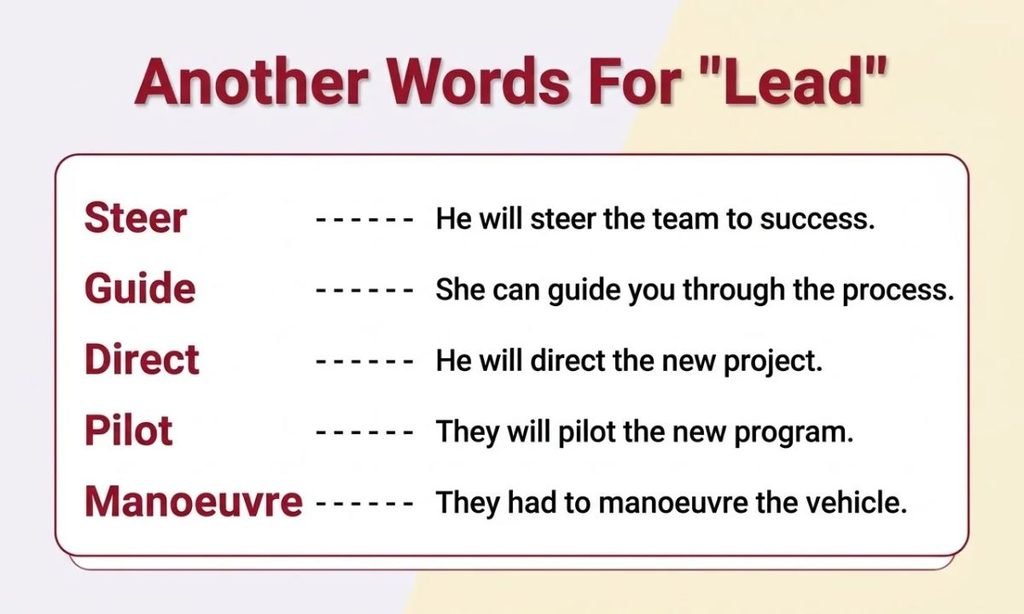
Pilot
Context & Usage: Pilot means to lead something through a trial or tricky stretch. It fits new programs, tests, and early-stage projects. It feels hands-on and careful.
Examples:
- Our team will pilot the new process this spring.
- She piloted the project through two difficult quarters.
Shepherd
Context & Usage: Shepherd means to guide people or projects with steady care. It fits leaders who protect a group while moving it forward. It feels caring and patient.
Examples:
- He shepherded the proposal through every approval.
- She shepherded her students toward graduation.
Head
Context & Usage: Head means to hold the top position in a group or department. It suits job titles, committees, and teams. It sounds plain and official.
Examples:
- Maria heads the marketing department.
- He will head the hiring committee this year.
Command
Context & Usage: Command means to lead with clear authority, often in structured settings. It fits the military, emergencies, and strict chains of responsibility. It feels firm and serious.
Examples:
- The captain commanded a crew of forty.
- She commands respect in every room.
Spearhead
Context & Usage: Spearhead means to lead an effort from the front and start it moving. It fits campaigns, reforms, and new initiatives. It feels bold and energetic.
Examples:
- Priya spearheaded the clean-up campaign.
- The mayor will spearhead the new housing plan.
Oversee
Context & Usage: Oversee means to watch over work and make sure it goes well. It fits managers and project owners who check progress without doing every task. It feels steady and responsible.
Examples:
- He oversees daily operations at the warehouse.
- A senior editor oversees every final draft.
Supervise
Context & Usage: Supervise means to watch people or tasks closely and correct them as needed. It fits training, classrooms, and entry-level roles. It feels attentive and structured.
Examples:
- She supervises three interns this summer.
- An adult must supervise the lab sessions.
Manage
Context & Usage: Manage means to handle people, resources, or timelines on a regular basis. It fits everyday workplace talk and job descriptions. It feels practical and reliable.
Examples:
- He manages a team of eight analysts.
- She manages the budget and the schedule.
Take time to read: 35 Big Fan Synonyms: Best Words & Phrases for Every Context
Preside
Context & Usage: Preside means to lead a formal meeting or ceremony from the chair. It fits boards, courts, and official events. It feels formal and traditional.
Examples:
- The chair will preside over Friday’s meeting.
- A judge presided over the hearing.
Pioneer
Context & Usage: Pioneer means to be among the first to try something new. It fits science, technology, and creative fields. It feels inventive and brave.
Examples:
- Her lab pioneered a faster testing method.
- They pioneered remote-first hiring in their industry.
Set the Pace
Context & Usage: Set the pace means to lead by example so others keep up. It fits sports, sales, and busy teams. It feels casual and motivating.
Examples:
- Dana sets the pace for the whole department.
- Our top runner set the pace for the first mile.
Call the Shots
Context & Usage: Call the shots means to make the final decisions. It fits casual talk about who holds real authority. It feels informal and a little blunt.
Examples:
- In this project, the client calls the shots.
- She finally got to call the shots on the design.
Be at the Helm
Context & Usage: Be at the helm means to hold the main leadership role over a group or company. It suits profiles, announcements, and speeches. It feels steady and respectful.
Examples:
- With a new CEO at the helm, the firm changed course.
- She has been at the helm of the school for ten years.
Outstrip
Context & Usage: Outstrip means to move ahead of others by a clear margin. It fits growth, speed, and performance comparisons. It feels strong and measurable.
Examples:
- Online sales have outstripped store sales this year.
- Demand outstripped our expectations.
Surpass
Context & Usage: Surpass means to go beyond a previous level or another competitor. It fits goals, records, and results. It feels formal and positive.
Examples:
- The team surpassed its quarterly target.
- Her second novel surpassed the first in sales.
Excel
Context & Usage: Excel means to be better than most at something. It fits praise in school, work, and sports. It feels confident and admiring.
Examples:
- He excels at explaining complex ideas simply.
- She excelled in every math competition.
Result In
Context & Usage: Result in means to cause a specific outcome. It fits reports, explanations, and cause-and-effect writing. It feels neutral and precise.
Examples:
- Poor planning resulted in a late launch.
- Small changes can result in big savings.
Prompt
Context & Usage: Prompt means to lead someone toward an action or response. It fits discussions, research, and design. It feels light and natural.
Examples:
- The error message prompted a quick fix.
- Her question prompted a lively debate.
Take time to read: Synonyms for No: 60 Better Ways to Say No
Spur
Context & Usage: Spur means to push something forward with fresh energy. It fits growth, change, and motivation. It feels lively and encouraging.
Examples:
- Lower prices spurred a wave of new buyers.
- The deadline spurred everyone to finish early.
Advantage
Context & Usage: Advantage names a better position compared with others. It fits competition, planning, and strategy. It feels clear and objective.
Examples:
- Their speed gave them a real advantage.
- Local knowledge was our biggest advantage.
Upper Hand
Context & Usage: Upper hand names a position of control in a contest or negotiation. It fits debates, deals, and sports. It feels vivid and conversational.
Examples:
- Better data gave her the upper hand in the talks.
- Neither side held the upper hand for long.
Edge
Context & Usage: Edge names a small but useful advantage over a rival. It fits business, sports, and job applications. It feels sharp and modern.
Examples:
- Fluency in two languages gave him an edge.
- A faster checkout gave the store its edge.
Vanguard
Context & Usage: Vanguard names the group that moves first in a field or movement. It fits innovation, politics, and the arts. It feels formal and forward-looking.
Examples:
- The company stayed in the vanguard of clean energy.
- Young designers led the vanguard of the movement.
Forefront
Context & Usage: Forefront names the most important or visible position. It fits discussions of trends, research, and public debate. It feels current and prominent.
Examples:
- Safety stayed at the forefront of every decision.
- She is at the forefront of language research.
Clue
Context & Usage: Clue names a piece of evidence that points toward an answer. It fits investigations, puzzles, and problem solving. It feels curious and suspenseful.
Examples:
- A torn receipt gave detectives their first clue.
- The pattern in the data was a useful clue.
Tip
Context & Usage: Tip names a useful piece of information passed along to someone. It fits news, police work, and everyday advice. It feels helpful and informal.
Examples:
- An anonymous tip started the investigation.
- A friend’s tip helped me find the apartment.
Hint
Context & Usage: Hint names a small sign that suggests something without stating it. It fits games, teaching, and polite conversation. It feels subtle and friendly.
Examples:
- Her smile was the only hint of good news.
- The teacher gave us a hint before the quiz.
Lede
Context & Usage: Lede is the journalist’s spelling for the opening of a news story. It fits newsrooms, editing, and writing classes. It feels professional and specific to the trade.
Examples:
- The editor rewrote the lede to be shorter.
- A strong lede tells readers why the story matters.
Star
Context & Usage: Star names the main performer or most important person in a project. It fits film, theater, and sports. It feels glamorous and appreciative.
Examples:
- The young actor is the star of the new series.
- She was the star of the team all season.
Prospect
Context & Usage: Prospect names a person or company that might become a customer. It fits sales, marketing, and customer teams. It feels professional and focused on real potential.
Examples:
- Each prospect received a personal follow-up email.
- She moved three prospects into the final stage.
Lead Antonyms to Know
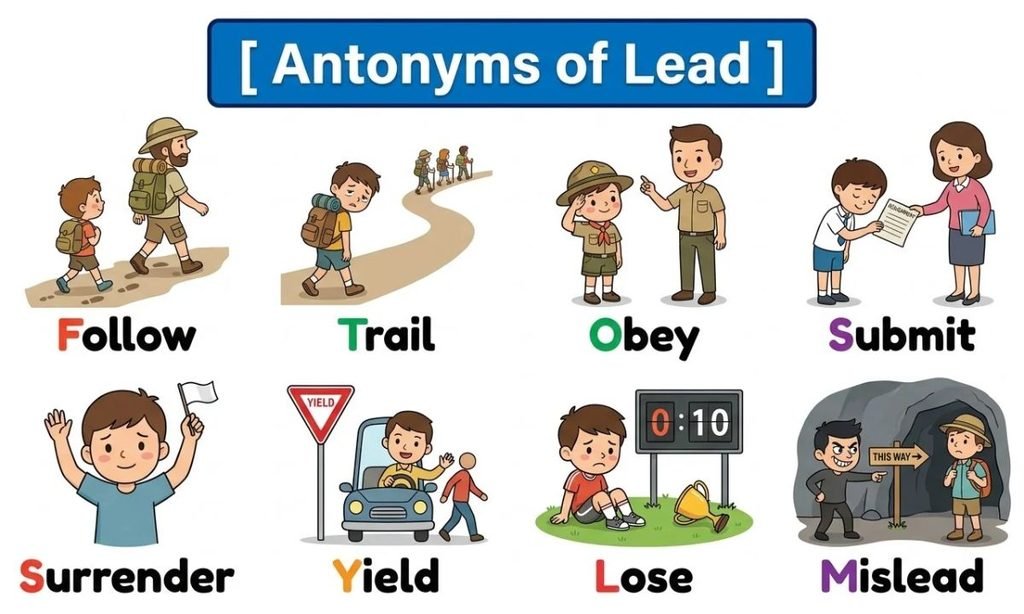
Lead antonyms help you show contrast and sharpen your meaning.
- Follow: go behind someone or accept their direction.
- Trail: stay behind in a race or contest.
- Lag: fall behind in pace or progress.
- Hinder: slow or block progress.
- Obey: act under another person’s command.
Use them when you want to contrast leaders with the people or groups behind them.
How to Pick the Right Synonym
Before you choose another word for lead, ask three quick questions.
- What is the action? Guiding, managing, outperforming, and causing are all different jobs.
- Who is the audience? A board report and a team chat need different words.
- What feeling do you want? Warm words like usher and shepherd sit far from firm ones like command.
If two words seem close, pick the one that makes your sentence easier to picture.
Frequently Asked Questions
What is another word for lead when guiding someone?
Guide is the clearest choice, with steer and usher working well for gentler or more formal situations.
What are strong synonyms for lead in business?
Spearhead, oversee, head, and manage all sound strong and professional, depending on how much control you describe.
How do guide, steer, and direct differ?
Guide shares knowledge, steer nudges direction, and direct gives clear instructions.
What are common antonyms of lead?
Follow, trail, lag, and hinder are the most common opposites, depending on the meaning.
How do I avoid confusing lead the verb with lead the metal?
Check the pronunciation and context: the verb rhymes with “feed,” and the metal rhymes with “bed.”
Conclusion
Choosing the right synonyms for lead turns a flat sentence into a clear one, because each word shows whether you guide, manage, outperform, or simply point the way. With the tone matrix, the antonyms, and the 35 examples above, you can match your words to the situation without second guessing, and that steady precision builds the kind of communicative confidence people notice in every email, meeting, and story you write.

Hi, my name is Kalvin. I love to read and learn new words every day. On this site, I share easy synonyms and simple grammar tips. Let us learn and write better together!