

Precise words make your message land the way you mean it. A vague adjective forces your reader to guess how strong, how sharp, or how heated something really is. “Intense” is a useful word, but it often hides more than it shows. The right synonym tells readers whether you mean pain, passion, pressure, or focus. This guide gives you 35 alternatives, sorted by meaning, tone, and real-world use. Use it to pick the word that fits, not just the word that sounds strong.
Quick Definition of Intense
Intense is an adjective that describes an extreme degree of force, power, feeling, or effort. It covers two broad senses: physical or situational strength (intense heat, intense pain) and deep emotion or concentration (intense devotion, intense focus). Most intense synonyms lean toward one sense or the other, so match your replacement to the meaning you need.
Synonyms for Extreme Force & Degree
This group describes strength you can measure or feel in the body and the world: heat, pain, storms, speed, and impact. Words like fierce, acute, severe, and overwhelming signal magnitude. Choose them when the focus is how much, not how passionate.
Synonyms for Passion & Strong Emotion
This group describes feeling driven from within: love, belief, loyalty, anger, and desire. Words like ardent, fervent, impassioned, and vehement carry emotional heat. Choose them when the focus is why someone cares, not how large the force is.
Synonyms by Context & Tone
Another word for intense depends on where you use it. Match register to setting.
Work, Pressure & Competition
Use strenuous, grueling, relentless, and concentrated for business, analytics, training, and sport. These words suit reports, performance reviews, and fitness writing.
Creative & Emotional Writing
Use gripping, riveting, feverish, burning, and consuming in storytelling. They create mood and pull readers into a scene.
Everyday & Casual Speech
Use strong, heavy, sharp, and heated in conversation. Save words like excruciating, fanatical, and violent for moments that truly deserve them, because over-escalation weakens your credibility.
Register at a Glance
Formal and academic: acute, profound, severe, vehement, concentrated. Neutral: strong, deep, powerful, keen, heated. Expressive and creative: fiery, burning, feverish, gripping, consuming.
Intense vs. Intensive & Intently
Three look-alike words cause frequent errors. Intense describes degree or feeling. Intensive describes thorough, concentrated effort over a short span. Intently describes how someone pays attention.
When to Use Intensive
Use intensive for methods, programs, and care: intensive course, intensive care, labor-intensive work. If you can replace it with “thorough” or “concentrated,” intensive is correct. Say “intense heat,” but “intensive training.”
Intensely vs. Intently Explained
Intensely describes degree: she was intensely curious. Intently describes focused attention: she listened intently. When you mean strong feeling or force, choose intensely. When you mean fixed attention, choose intently.
Extreme
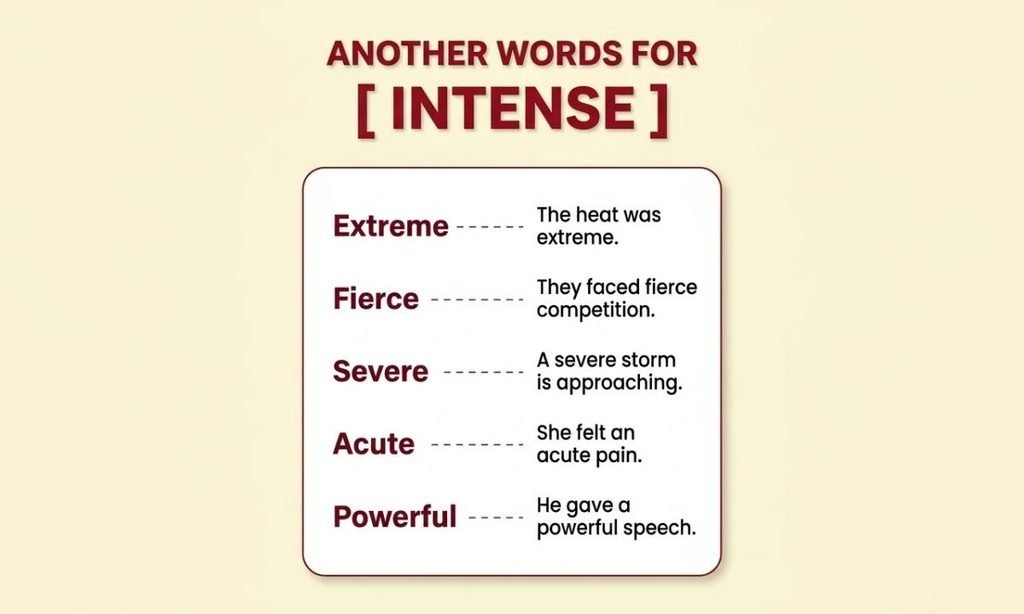
Context & Usage: Extreme describes the outer limit of a quality, such as temperature, risk, or opinion. It fits factual writing and everyday speech when you want to signal that something sits far beyond normal. It adds scale without adding emotion.
- The hikers faced extreme cold above the tree line.
- Her extreme caution kept the project on track.
Fierce
Context & Usage: Fierce describes aggressive strength, whether in animals, competition, or loyalty. It fits sports, debate, and character descriptions. It carries admiration, so readers often hear courage in it.
- The two teams played a fierce match in the final.
- She defended her colleagues with fierce loyalty.
Ferocious
Context & Usage: Ferocious pushes fierce toward savage, untamed force. It fits storms, appetites, and wild animals. Use it when you want a vivid, slightly dangerous image.
- A ferocious wind tore through the valley overnight.
- He attacked the deadline with a ferocious appetite for work.
Violent
Context & Usage: Violent describes sudden, destructive force. It fits storms, collisions, and sharp reactions, and it should stay literal when possible. Avoid it for mere passion, since it implies harm or loss of control.
- A violent storm shook the windows all night.
- The market took a violent swing after the announcement.
Acute
Context & Usage: Acute describes something sharp, sudden, and severe, especially pain, shortage, or awareness. It fits medical, formal, and analytical writing. It signals precision, not drama.
- The patient felt acute pain in his lower back.
- The region faces an acute shortage of skilled workers.
Severe
Context & Usage: Severe describes harsh, serious intensity that causes real consequences. It fits weather, illness, penalties, and criticism. It sounds measured and authoritative.
- Severe delays disrupted flights across the country.
- The manager issued a severe warning about missed targets.
Excruciating
Context & Usage: Excruciating describes pain or tension so strong it is almost unbearable. Reserve it for true agony or painful suspense, because overuse flattens its force. It gives readers an immediate physical sense of suffering.
- The excruciating wait for the test results lasted three days.
- He described the cramp as excruciating.
Worth every single page:Synonyms for Developed: 60 Stronger Words by Context
Profound
Context & Usage: Profound describes intensity with depth, often emotional or intellectual. It fits reflective writing, speeches, and serious subjects. It suggests lasting weight, not surface heat.
- The loss left a profound sense of emptiness.
- Her book had a profound effect on young readers.
Deep
Context & Usage: Deep describes strong feeling or serious degree without formality. It fits personal writing and everyday talk. It feels warm, steady, and sincere.
- They share a deep respect for each other’s work.
- He took a deep breath and began to speak.
Consuming
Context & Usage: Consuming describes a feeling or interest that takes over your attention and energy. It fits obsessions, passions, and ambitions in narrative or reflective writing. It suggests the feeling has no room left for anything else.
- Her consuming curiosity pushed her to study every night.
- A consuming fear shaped every decision he made.
Overwhelming
Context & Usage: Overwhelming describes a force or feeling too large to handle easily. It fits emotion, workload, and numbers. It builds empathy because it shows the reader the person’s limits.
- The team felt overwhelming pressure before the launch.
- Voters gave the proposal overwhelming support.
Powerful
Context & Usage: Powerful describes strong effect, influence, or impact. It fits speeches, products, images, and emotions in both formal and casual writing. It is a safe, confident choice when you need strength without heat.
- The film closes with a powerful final scene.
- She felt a powerful urge to speak up.
Forceful
Context & Usage: Forceful describes strong, direct, hard-to-resist energy in action or speech. It fits persuasion, leadership, and argument. It signals confidence and control, not rage.
- He made a forceful case for changing the policy.
- The coach gave a forceful speech at halftime.
Heightened
Context & Usage: Heightened describes a quality that has been raised above its usual level, such as awareness, tension, or security. It fits news, business, and analytical writing. It suggests a change over time, not a constant state.
- Heightened tension filled the meeting room.
- The attack led to heightened security at the station.
Concentrated
Context & Usage: Concentrated describes strong effort or force focused on one point. It fits study, training, and work sessions. It communicates discipline and clear direction.
- She made a concentrated effort to finish the draft by noon.
- The program offers concentrated practice in speaking.
Ardent
Context & Usage: Ardent describes warm, eager devotion to a person, cause, or hobby. It fits formal and literary writing, and it suits admiration more than anger. It conveys loyalty with a touch of romance.
- He is an ardent supporter of local theater.
- Her ardent belief in the project inspired the team.
Fervent
Context & Usage: Fervent describes sincere, burning enthusiasm shown through action or belief. It fits speeches, hobbies, and causes in polished or expressive writing. It signals warmth and conviction without anger.
- She gave a fervent thank-you to the volunteers.
- Fans filled the stadium with fervent chants.
Impassioned
Context & Usage: Impassioned describes speech or effort driven by strong feeling. It fits appeals, debates, and performances. It tells readers the speaker cares deeply and wants them to care too.
- The mayor made an impassioned plea for funding.
- He delivered an impassioned closing argument.
Vehement
Context & Usage: Vehement describes forceful, often angry, insistence. It fits disagreement, denial, and protest in formal and neutral writing. It signals strong conviction and a refusal to back down.
- She offered a vehement denial of the claim.
- The board met vehement opposition from residents.
Fiery
Context & Usage: Fiery describes hot temper, bold spirit, or vivid heat. It fits personalities, speeches, and colors in creative and everyday writing. It adds energy and a hint of risk.
- The coach gave a fiery speech before the final.
- A fiery sunset lit the whole harbor.
Zealous
Context & Usage: Zealous describes tireless, eager commitment to a cause or goal. It fits advocacy, work, and belief. Use it with care, since it can imply the person is pushing too hard.
- The zealous intern checked every figure twice.
- He was a zealous defender of public parks.
Burning
Context & Usage: Burning describes a strong, restless desire or sense of urgency. It fits ambition, questions, and resentment in expressive writing. It makes the feeling visible, like heat you cannot ignore.
- She had a burning desire to start her own studio.
- The burning question was who would pay for it.
Passionate
Context & Usage: Passionate describes strong feeling and deep interest in someone or something. It fits everyday speech, resumes, and personal stories. It is warm and positive, so it works almost anywhere.
- He is passionate about teaching young coders.
- They had a passionate debate about the ending.
Earnest
Context & Usage: Earnest describes serious, sincere intensity, often quiet and honest. It fits requests, effort, and personal appeals. It builds trust because it sounds free of performance.
- She made an earnest attempt to repair the friendship.
- The student asked an earnest question about the exam.
Keen
Context & Usage: Keen describes sharp interest, eagerness, or sensitivity. It fits workplace writing, observation, and everyday talk. It is positive, active, and modest in tone.
- He took a keen interest in data analysis.
- She has a keen sense of timing.
Sharp
Context & Usage: Sharp describes sudden, cutting intensity in pain, change, or contrast. It fits physical sensations, prices, and tone of voice in casual and neutral writing. It gives a quick, clear sense of edge.
- A sharp pain shot through her wrist.
- Sales saw a sharp rise in the last quarter.
Do not miss this: During Synonym: 30 Other Words for During
Harsh
Context & Usage: Harsh describes intensity that feels rough, unpleasant, or unforgiving. It fits light, weather, criticism, and conditions. It warns the reader that the experience is uncomfortable.
- The harsh glare made it hard to read the screen.
- He received harsh feedback on his first draft.
Gripping
Context & Usage: Gripping describes something so engaging that it holds your full attention. It fits stories, films, matches, and presentations. It praises the experience and promises momentum.
- The author wrote a gripping thriller set in Lisbon.
- It was a gripping finish to the season.
Riveting
Context & Usage: Riveting describes content so compelling you cannot look away. It fits talks, performances, and reporting. It is more polished than gripping and a little more formal.
- Her riveting talk kept the room silent.
- The documentary offers a riveting look at deep-sea life.
Fanatical
Context & Usage: Fanatical describes extreme, uncritical devotion that goes beyond reason. It fits strong criticism or humor and should be used carefully, since it often sounds negative. It warns readers that enthusiasm has crossed a line.
- He is fanatical about keeping his desk spotless.
- The group’s fanatical loyalty alarmed outside observers.
Feverish
Context & Usage: Feverish describes restless, hurried, almost overheated activity or emotion. It fits creative writing, news, and tense scenes. It suggests energy that is slightly out of control.
- The crew worked at a feverish pace before opening night.
- Feverish excitement spread through the crowd.
Heated
Context & Usage: Heated describes tense, angry, or emotionally charged exchanges. It fits arguments, debates, and negotiations in everyday and professional writing. It signals strong feeling that has not yet become hostile.
- The two leaders had a heated exchange on stage.
- A heated discussion followed the vote.
Strenuous
Context & Usage: Strenuous describes activity that demands great physical or mental effort. It fits training, hiking, and demanding projects in practical, fitness, or business writing. It sets honest expectations about the work ahead.
- The trail is a strenuous climb of six hours.
- She followed a strenuous training plan for the marathon.
Grueling
Context & Usage: Grueling describes effort that is exhausting and tests endurance over time. It fits long projects, competitions, and travel. It adds respect for the person who got through it.
- The team survived a grueling twelve-week sprint.
- He finished a grueling race in the heat.
Unrelenting
Context & Usage: Unrelenting describes force or pressure that does not ease or stop. It fits weather, schedules, and criticism in neutral and creative writing. It tells readers the strain is constant, not a passing peak.
- The team faced unrelenting pressure all season.
- Unrelenting rain flooded the village roads.
Antonyms for Intense
The antonyms for intense help you check your tone from the other side. Use mild, gentle, and calm for soft force or feeling. Use moderate, measured, and restrained for controlled degree in formal writing. Use detached, casual, and low-key for lack of emotional investment. When a sentence feels too strong, test a calmer opposite before you decide.
Tips to Choose the Right Word
Start by naming what is intense: force, feeling, effort, or attention. Then match the word to the setting, formal, neutral, or expressive. Pick a precise word over a loud one, and save extreme options such as excruciating, violent, and fanatical for moments that earn them.
Pair each synonym with natural nouns, such as acute pain, fervent belief, or strenuous training. Read the sentence aloud, and keep the version that sounds true to the moment.
Frequently Asked Questions
What is another word for intense?
Strong, extreme, fierce, and profound are common choices, depending on whether you mean force or feeling.
How do you describe someone who is intense?
Call them passionate, focused, driven, or ardent, and avoid fanatical unless their devotion is extreme.
What is the difference between intense and intensive?
Intense describes strong degree or feeling, while intensive describes thorough, concentrated effort, as in intensive training.
What are antonyms for intense?
Mild, calm, gentle, moderate, and detached are the most useful opposites.
Is intensely the same as intently?
No, intensely describes strong degree, while intently describes fixed, focused attention.
Conclusion
Mastering these alternatives to intense makes your writing sharper, more honest, and easier to trust. You learn to separate force from feeling, formal from casual, and passion from pressure, so each word fits its moment.
With precise choices, readers understand exactly what you mean and how strongly you mean it. That clarity builds communicative confidence, and it turns an overused adjective into a deliberate, well-chosen word.

Hi, my name is Kalvin. I love to read and learn new words every day. On this site, I share easy synonyms and simple grammar tips. Let us learn and write better together!


2 thoughts on “Synonyms for Intense: 35 Sharper Words for Extreme Force”