

The right word does more work than a long explanation. When you say “navigate” every time, your writing starts to blur. A sailor, a manager, and a website visitor all navigate, but in very different ways. Precise vocabulary tells readers exactly what kind of movement or effort you mean. This guide gives you synonyms for navigate, sorted by context and tone. Pick the word that fits your situation and your sentence gets sharper.
What “Navigate” Means Across Contexts
“Navigate” is a verb. At its core, it means to plan, steer, or find a way along a route or through a situation.
It shows up in three main settings:
- Physical travel: driving, sailing, flying, or hiking along a route.
- Digital spaces: moving through a website, an app, or a menu.
- Hard situations: working through a conflict, a system, or a tough season of life.
If you are searching for another word for navigate, start by asking which of these three you mean. Most weak word choices come from skipping that step.
Navigate vs. Steer, Guide, and Explore
These near-synonyms get swapped all the time, but they are not identical.
| Word | Main focus | Best used when |
| Navigate | Finding and following a route | You are planning or tracking the way |
| Steer | Physical control and turning | You are operating the vehicle or wheel |
| Guide | Leading other people | Someone else depends on your direction |
| Explore | Discovery | You do not know the destination yet |
A short test helps. If you are in control of the wheel, use steer. If you are leading others, use guide. If you are curious about what is out there, use explore. If you are working out the route, navigate fits.
Formal vs. Casual Register
Many navigate synonyms change tone depending on the room you are in.
- Formal: negotiate, circumvent, traverse, orient, chart.
- Neutral: guide, direct, manage, cross, explore.
- Casual: handle, get through, wade through, find your way, work through.
In a legal memo, “circumvent the regulation” sounds right. In a chat with a coworker, “get around it” is what people actually say. Match the word to the audience, not to what sounds impressive.
Digital and UX Writing Uses
Words related to navigate matter more than ever in product and web copy.
- Browse suggests casual scanning with no fixed goal.
- Scroll through describes a specific physical action on a screen.
- Wayfind is a design term for helping users orient themselves in a space.
- Jump to works well for links that skip ahead on a page.
Use “navigate” for menus and site structure. Use “browse” when the visitor is just looking around.
How to Choose the Right Synonym
Run through these three questions before you swap a word:
- What is moving? A person, a vehicle, a ship, or an idea.
- What is in the way? Terrain, water, rules, or emotions.
- Who is the reader? A specialist, a customer, or a general audience.
The answers usually point to one or two strong options. The 35 alternatives below are grouped loosely from physical to figurative.
Steer
Context & Usage: Steer means to control the direction of a vehicle, a boat, or a conversation. It fits when you are the one holding the wheel and making turns. It carries a sense of calm control and responsibility.
Examples:
- She steered the truck around the fallen branches.
- He steered the meeting back to the budget.
Pilot
Context & Usage: Pilot means to guide a ship, aircraft, or project through a defined path. It suggests skill and authority, often in technical settings. It tells readers that someone competent is in charge.
Examples:
- Maria piloted the small plane through the storm.
- He piloted the team through its first product launch.
Helm
Context & Usage: Helm means to take charge of a vessel or an organization. It works best in formal or leadership writing. It carries weight and signals ownership of the outcome.
Examples:
- She helmed the company through three difficult years.
- A veteran captain helmed the ship into the harbor.
Sail
Context & Usage: Sail means to travel across water, or to move smoothly through something. In figurative use it suggests ease and confidence. Choose it when the path feels effortless.
Examples:
- They sailed across the bay before sunset.
- He sailed through the interview without a single stumble.
Cruise
Context & Usage: Cruise means to travel at a steady, comfortable pace. It fits roads, water, and even easy projects. It conveys relaxation and low stress.
Examples:
- We cruised along the coast with the windows down.
- The team cruised through the first round of testing.
Voyage
Context & Usage: Voyage means to make a long journey, usually by sea or space. It adds a sense of scale and purpose. Use it when the trip matters as much as the destination.
Examples:
- The crew voyaged for months before sighting land.
- She voyaged across three continents to finish her research.
Traverse
Context & Usage: Traverse means to travel across or through an area, especially a large or difficult one. It suits formal writing, geography, and outdoor settings. It gives your sentence a measured, serious tone.
Examples:
- Hikers traverse the ridge in about six hours.
- The cable traverses the entire length of the tunnel.
Truly worth your time: 35 Big Fan Synonyms: Best Words & Phrases for Every Context
Cross
Context & Usage: Cross means to go from one side of something to the other. It is plain, direct, and works in almost any setting. Reach for it when you want simple and clear.
Examples:
- They crossed the river on a narrow footbridge.
- She crossed the crowded plaza to meet her friend.
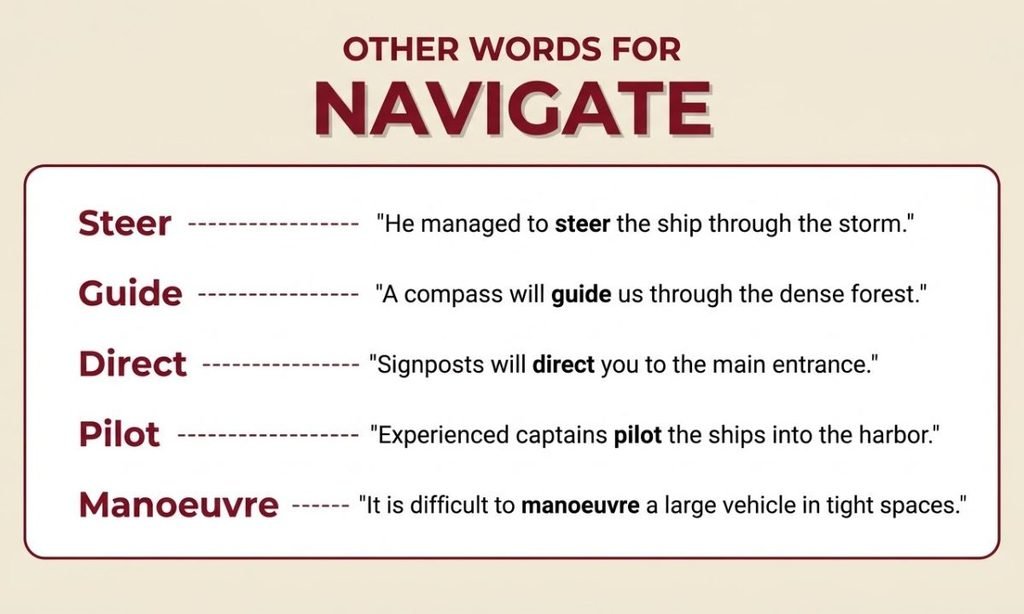
Maneuver
Context & Usage: Maneuver means to move skillfully through a tight or tricky space. It fits driving, sports, and office politics. Note that British English spells it “manoeuvre.” It signals precision and quick thinking.
Examples:
- He maneuvered the van into a space barely wider than the car.
- She maneuvered carefully around the sensitive topic.
Guide
Context & Usage: Guide means to lead someone along a route or process. It focuses on helping others rather than moving yourself. It builds trust because it shows care for the person following.
Examples:
- The ranger guided us along the trail.
- She guided new hires through the onboarding process.
Direct
Context & Usage: Direct means to point someone or something toward a destination. It works in traffic, management, and instructions. It sounds firm and clear without being harsh.
Examples:
- An officer directed drivers around the closed lane.
- He directed the team toward the most urgent tasks.
Chart
Context & Usage: Chart means to plan or record a route in detail. It suits maps, strategy, and careful planning. It tells readers that the path was studied and not guessed.
Examples:
- The crew charted a course around the reef.
- We charted a plan for the next quarter.
Plot a Course
Context & Usage: Plot a course means to decide the route before you begin moving. It works for travel and long-term plans alike. It communicates foresight and deliberate choices.
Examples:
- The captain plotted a course north before dawn.
- She plotted a course for her career over the next five years.
Map Out
Context & Usage: Map out means to lay out a route or plan step by step. It is friendly and works in both speech and writing. It makes a complex path feel manageable.
Examples:
- Let’s map out the drive before we leave.
- He mapped out each stage of the project on a whiteboard.
Find Your Way
Context & Usage: Find your way means to work out the right direction when it is not obvious. It is warm, casual, and works well for people. It carries a hint of persistence and self-reliance.
Examples:
- It took her a week to find her way around the new campus.
- New users can find their way through the app in minutes.
Wayfind
Context & Usage: Wayfind means to orient yourself and choose a path in a physical or digital space. It is common in design, architecture, and UX writing. It signals expert, user-focused thinking.
Examples:
- Clear signs help visitors wayfind through the hospital.
- Good menus let customers wayfind without thinking about it.
Browse
Context & Usage: Browse means to look through content casually without a fixed target. It is the natural pick for shops, websites, and libraries. It feels relaxed and low pressure.
Examples:
- I browsed the catalog for an hour before choosing.
- Visitors can browse by category or search by keyword.
Explore
Context & Usage: Explore means to move through a place or idea in order to discover it. Unlike navigate, it does not assume you know the route. It brings curiosity and energy to a sentence.
Examples:
- We explored the old town on foot.
- She explored several career options before settling on design.
Move Through
Context & Usage: Move through means to travel across a space or stage in a plain, neutral way. It works for crowds, buildings, and processes. Use it when you do not want to add extra meaning.
Examples:
- Guests moved through the gallery in small groups.
- Each application moves through three review stages.
Journey Through
Context & Usage: Journey through means to travel across a place or experience over time. It adds a story-like feel. Choose it when the path is meaningful and the pace is slow.
Examples:
- The book journeys through a century of family history.
- They journeyed through the mountains for two weeks.
Negotiate
Context & Usage: Negotiate means to get past an obstacle with care and skill. It fits formal writing about terrain, traffic, or complex systems. It suggests effort, judgment, and a steady hand.
Examples:
- Drivers had to negotiate a series of sharp turns.
- She negotiated the company’s complicated approval process.
Handle
Context & Usage: Handle means to deal with a situation in a practical way. It is casual and common in daily speech. It sounds capable without sounding stiff.
Examples:
- He handled the angry customer calmly.
- She handled the sudden schedule change without complaint.
Manage
Context & Usage: Manage means to deal with a task or problem successfully. It works in both work and personal settings. It communicates control over something difficult.
Examples:
- They managed a tight deadline with no extra staff.
- He managed his stress by walking every morning.
Truly worth your time: Hubby Synonyms: 32 Better Words for Your Husband
Cope With
Context & Usage: Cope with means to deal with something hard, often emotional. It fits stress, loss, and heavy workloads. It shows honesty about difficulty, which builds empathy with readers.
Examples:
- Many families cope with rising costs by cutting back.
- She coped with the move by staying in touch with old friends.
Work Through
Context & Usage: Work through means to deal with a problem step by step until it is resolved. It suits emotions, conflicts, and tasks. It suggests patience and steady progress.
Examples:
- The couple worked through their disagreement over dinner.
- We worked through the backlog one ticket at a time.
Tackle
Context & Usage: Tackle means to take on a problem with energy. It is informal and action-focused. It shows readers you are ready to act.
Examples:
- The group tackled the budget problem first.
- He tackled the long reading list over the summer.
Get Through
Context & Usage: Get through means to make it to the end of something difficult. It is casual and relatable. It speaks to endurance more than to skill.
Examples:
- We got through the busy season with a lot of coffee.
- She got through the exam with careful preparation.
Wade Through
Context & Usage: Wade through means to move slowly and with effort through something heavy, like paperwork or deep water. It carries a mild sense of tedium. Use it when the effort feels long and unglamorous.
Examples:
- I waded through hundreds of emails after vacation.
- The hikers waded through knee-deep mud.
Weave Through
Context & Usage: Weave through means to move around obstacles in a flowing path. It suits traffic, crowds, and tight spaces. It paints a quick, graceful picture.
Examples:
- The cyclist wove through slow traffic.
- She wove through the crowded market without breaking stride.
Thread Your Way Through
Context & Usage: Thread your way through means to move carefully through a narrow or crowded path. It implies patience and precision. It works well when the gaps are small.
Examples:
- He threaded his way through the packed train car.
- She threaded her way through the contract’s fine print.
Circumvent
Context & Usage: Circumvent means to find a way around an obstacle or rule. It is formal and can sound slightly sneaky. Use it carefully, since readers may read it as avoiding the rules.
Examples:
- The crew circumvented the flooded road by taking the ridge path.
- The new software circumvents the old approval step.
Sidestep
Context & Usage: Sidestep means to avoid a problem or question by stepping around it. It is casual and slightly critical. It suggests dodging rather than solving.
Examples:
- The mayor sidestepped the question about taxes.
- She sidestepped the argument by changing the subject.
Orient Yourself
Context & Usage: Orient yourself means to get your bearings in an unfamiliar place or situation. It works for new cities, new jobs, and new tools. It sounds calm and reassuring to a reader who feels lost.
Examples:
- Take a few minutes to orient yourself before you start.
- New employees orient themselves through a short walkthrough.
Lead
Context & Usage: Lead means to go first and show the way for others. It fits teams, trails, and projects. It carries confidence and responsibility.
Examples:
- Our scout led the group through the dense forest.
- She led the department through a major restructuring.
Make Your Way
Context & Usage: Make your way means to move toward a goal, often with effort. It is simple, natural, and good for storytelling. It suggests steady progress without drama.
Examples:
- We made our way through the crowd toward the exit.
- He made his way up the company ladder one step at a time.
Antonyms of Navigate
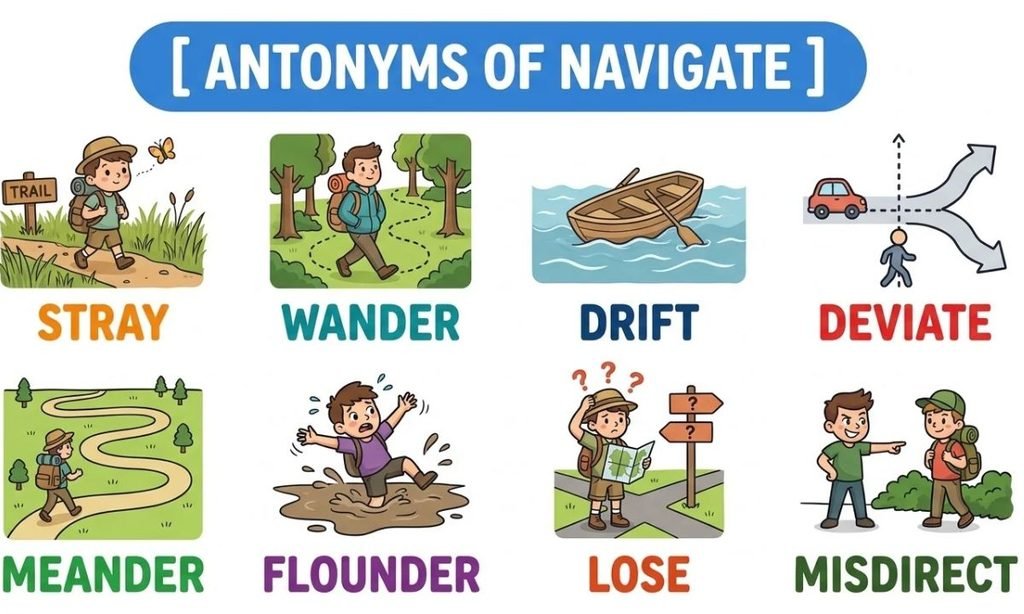
Knowing the antonyms of navigate helps you see the word’s edges. Opposites tend to describe loss of direction or lack of care:
- Get lost: to lose your way completely.
- Wander: to move without a plan or goal.
- Stray: to drift away from the intended path.
- Drift: to move without control or direction.
- Neglect: to fail to guide or attend to something.
- Flounder: to struggle without making progress.
Use these when you want to contrast confident movement with confusion. “She wandered for an hour” and “she navigated the city” tell very different stories.
Stretched or Misleading Synonyms to Watch Out For
Many online lists pad their numbers with weak or out-of-context pairings. Word counts also vary widely. Curated dictionary entries often list 15 to 40 terms, while crowd-sourced lists can run past 1,000. Larger does not mean better.
Be careful with these habits:
- Out-of-context terms: words like “jaywalk” or “hijack” rarely mean the same thing as navigate.
- Unchecked lists: crowd-submitted or automated lists often skip editorial review.
- Register mismatches: “circumvent” in a casual email can sound stiff or sly.
Before you swap a word, read your sentence out loud. If the new word changes the meaning, put the original back.
Frequently Asked Questions
What is a formal synonym for navigate?
Traverse, negotiate, and chart are strong formal choices depending on context.
What is the difference between navigate and explore?
Navigate assumes you are following a route, while explore assumes you are discovering one.
What is a synonym for navigate a difficult situation?
Work through, handle, and cope with all fit, with “work through” being the most natural.
Is guide a synonym for navigate?
Partly, since guide focuses on leading others, while navigate focuses on finding the route.
What is another word for navigate a website?
Browse, scroll through, and move through are the most common and natural choices.
Conclusion
Choosing among these synonyms for navigate is a small habit that pays off in every sentence you write, because each word carries its own tone, setting, and level of effort. When you match the word to the situation, readers understand your meaning faster and trust your writing more. Keep this list nearby, test each swap by reading it aloud, and you will write and speak with more clarity and confidence.

Hi, my name is Kalvin. I love to read and learn new words every day. On this site, I share easy synonyms and simple grammar tips. Let us learn and write better together!


2 thoughts on “Synonyms for Navigate: 35 Clear Alternatives by Context”